Tuesday, April 17, 2012

Connectivity

Beatrice Lithby, OBE. Queen Mary's Army Auxiliary Corps Signallers, ca 1914-18. © IWM, Item Art.IWM ART 2900
Dear patient readers, I write after an unexpected technological debacle has left me temporarily without access to those electronically mediated channels of ether otherwise known as the internet. Moving brings its share of surprises and, while most of them have been quite pleasant, we are still actively engaged in the process of establishing web connectivity for ourselves in our new home. It shall be done quite soon and I shall return to my regularly scheduled posts.

For now, I am writing you from a local cafe and thought that I would seek out a relevant image to share with you. This delightful drawing shows a set of female operators at work with male officers at a telephone exchange in France. Telephone communication was an important technological aspect of this war and it is interesting to see the uniformed operators seated at their switchboards as the male officers use the telephone. Information could be exchanged quickly between those in command and those on the front via the telephone, although the device was subject to hazards such as lines being cut, as Gilbert Holiday's chalk and charcoal illustration below depicts:

Gilbert Holiday. The Observation Post: 'No reply, Sir...Line cut again!' ca 1914-18. © IWM, Item Art.IWM ART 185   
Just as easily as we establish reliance upon modern communication technologies, our access to such cutting-edge resources can, well, be cut. The soldiers above are shown at a moment of such failure,  as they discover that the telephone line is out. The officer turning to listen to the other man's report seems caught just before snapping into some kind of reaction or plan, binoculars still in hand and suggesting the vital nature of the connectivity that a field telephone could provide to those in the trenches.

Though I remain somewhat in the trenches of moving, our lines of communication will be established soon (it is hoped) and I shall return to a more frequent pattern of blogging here at "Ghosts of 1914." Please do continue to read and feel free to submit questions or suggestions via the comments section. Many thanks for tuning in!

© Fiona Robinson

Thursday, April 5, 2012

Lord Kitchener's Form

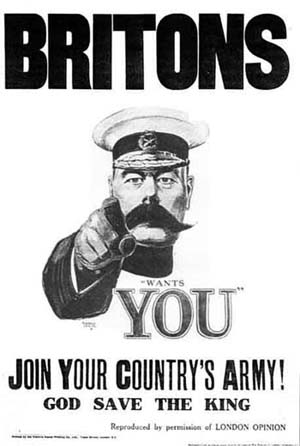
Leete, Alfred. "Lord Kitchener Wants You," 1914.

The man pictured in what some would describe as the quintessential modern military recruitment poster is none other than Lord Kitchener (1850-1916), one of the most iconic figures of the Great War. Alfred Leete's striking 1914 image features a disembodied head and pointing arm, as though the great man emerges from a foggy blank space to find and address us.  We, the viewers, feel somehow more visible under the fierce gaze of this imposing figure, though he appears before us only in partial form. 

Kitchener, as his biographical details reveal, was born in Ireland and became a major player in British imperial conquests and conflicts during the nineteenth and early twentieth centuries. In 1914, he was appointed Secretary of State for War.

"Lord Kitchener Says," Parliamentary Recruiting Comm., Great Britain. Lithograph, 1915. © IWM (Art.IWM PST 0309)
Kitchener's work as the Secretary of State for War was mired in controversy, primarily because of severe shortages in weapon supplies. The iconic status that had helped to recruit multitudes to the British Army began to shift towards the mid-point of the war. Public sentiment was mixed regarding Kitchener's untimely death en route to Russia in 1916, during an event of staggeringly tragic proportion. The military leader's ship, the HMS Hampshire, struck a German mine and sank near the Orkney islands, killing over six hundred people who were aboard. Jane Storey's commemorative history site offers considerable information and media related to the Hamphire disaster. 

Dick, W. Reid. Kitchener Memorial at All Souls' Chapel, St. Paul's Cathedral, London, 1925.

Controversy continued to follow Kitchener even after his death, though he was memorialized in grand and prolific fashion. A striking effigy (seen above) was installed as part of the 1925 All Souls' Chapel, which honors Kitchener and all of the war's fallen service-people at St. Paul's Cathedral, London.  The effigy takes on a certain irony or strangeness, it is worth noting, in light of the fact that Kitchener's body was never recovered from sea. British Pathé has an impressive set of viewable short films documenting services for and monuments to Kitchener in the 1910s and 20s.


Kitchener Memorial, Orkney.

While there are statues, monuments, schools, and other prominent tributes to Kitchener in many places around the world, many other, very different, items commemorating this iconic and somewhat mysterious figure were made during the Great War. Not everyone agreed about the shape or nature of Kitchener's work and legacy, but the small material objects below, all from the Imperial War Museum's collection of ephemera and other objects, indicate a desire to capture his legendary presence in tactile and approachable--even lighthearted--form.
Kitchener Commemorative Matchbox, 1916. © IWM, Item EPH 1336.
Lord Kitchener Toby Jug, Royal Staffordshire Pottery, 1917. © IWM, Item EPH 8729.
Lord Kitchener doll, Britain, ca. 1914. © IWM, Item EPH 4083.
Kitchener's memory shifts through all of these shapes, reminding us of the ways in which the histories of war and the nature of wartime icons seem to resist clear or full materialization even as they are manifested over and over again in material modes--statues, monuments, dolls, ephemera. True form perhaps eludes capture, though (for history enthusiasts like myself) the pursuit never fails to thrill.

© Fiona Robinson


Sunday, March 18, 2012

Marching Orders

G.P. Lewis. Women war workers packing lamp bulbs, 1918. © IWM Item (Q 28172)
Dear Readers,
I write to beg your pardon for a brief hiatus here at "Ghosts of 1914." An unexpectedly sudden--but positive and exciting!--need to move has come to my husband and myself. Right now, we are packing and packing, ready to mobilize our little household and head to Western shores. I'll soon be writing from California, my native state. Though the times they are a changin' in some regards, I'll still be working on my dissertation and will still be energetically traveling the highways and byways of  the global-British experience of WWI. I hope you'll continue to join me for our journeys into this compelling  and persistently resonant area of modern history.

W.A. Fry (after), "There's Room for YOU," Australia, ca 1914-18. © IWM (Art.IWM PST 12246)

Please be patient and do stay tuned for my next post, which should pop up in about a week, once our feet are on Californian ground.

The stories will continue to be told and the ghosts will continue to be summoned...

With warm thanks for reading,
Fiona

Wednesday, March 7, 2012

Mods, Rockers, and Ghosts

A musical musing today for my readers: I'm listening to British band The Kinks' brilliant 1969 album Arthur: Or the Decline and Fall of the British Empire as I work on some writing projects this morning. While the entire album is worth a listen or fifty for many reasons, this song struck me as particularly resonant for those of us fascinated by the ghosts of 1914:


Two soldiers fighting in a trench
One soldier glances up to see the sun
And dreams of games he played when he was young
And then his friend calls out his name
It stops his dream and as he turns his head
A second later he is dead
The full lyrics to "Some Mother's Son" are here. 

Another song from the same era is The Zombies' nightmarish "Butcher's Tale (Western Front 1914)," written in 1968. The Guardian's Jon Savage writes about this piece:
"This is a serious song about an extremely serious subject that succeeds because of its restraint and complete synchronicity of form with content, of music with lyric, of feeling with imagination. The Zombies did not experience the western front, but they projected themselves into a terrible event with all the considerable talent at their disposal. "


The Great War and its ghosts certainly do have a lengthy and multifaceted afterlife and it is fascinating to explore the moments and places at which they manifest, even fifty or a hundred years on in time. May the music offer you some food for thought or some accompaniment to your projects today...

© Fiona Robinson


Tuesday, February 28, 2012

Cyclists to Arms!

Ibbetson, Ernest. "The London Cyclists," 1912. ©IWM, Art.IWM PST 0873.
Another delightful find from the archives, thanks to the IWM's web resources (once again). This dynamic 1912 image features a group of men in the 25th County of London Cyclist Battalion. This particular regiment, also known as the 25th London Cyclists, was established in 1908 as a division of the Territorial Forces.  The  unit has a dedicated website full of information and multimedia items. In his account of the regiment, historian Simon Parker-Galbreath writes,
"The London Cyclist Battalion patrolled the coast of England to watch for a German invasion. After air attacks began in May 1915, bicyclists with signs "Take Cover" warned British citizens to find shelter."
"Are You Fond of Cycling?" Poster, ca 1914-1918.  © IWM (Art.IWM PST 4893)

Parker-Galbreath notes that, while cyclists served on the battlefront as part of the British Army, the London Cyclists were an important part of homefront defense during the war years and eventually were dispatched to battlefields in the Middle East and India. There, they would continue to serve through the Great War's end until being demobilized in 1919. The 25th London website includes PDF images of the Battalion's periodical, The Londoner. It appears that this journal was published in India for battalion troops stationed there from 1916-1919.

25th London Cyclists Badge, ca 1908-22. © IWM, Item INS 7264.
The energy of the men in the poster, who have sprung from their cycles and stand poised for battle, is extremely compelling and somewhat disturbing. The troops stand with a quaint village behind them, placing themselves on the front lines of combat--between home and an English past, we might say, and an unknown and unnamed, but menacing, future. Their enemy is invisible, the threat it poses is unclear and unsettlingly vague. That the poster was created in 1912 suggests that a modern conflict was already sensed on the horizon, its reach feared powerful enough to touch English soil and shape the new century. Even at this early date, for our ghosts of 1914, war was already, chillingly, a phantom coming into view.


© Fiona Robinson

Monday, February 27, 2012

Every Fit Woman

Unknown Artist, "Every Fit Woman Can Release a Fit Man," ca. 1917-18. © IWM (Art.IWM PST 4881)
It's always so great to find an archival item just brimful of energy. This poster jumped out at me for exactly that reason amid a more general search of the Imperial War Museum's great Collections Database. The image features a bright and confident young woman waving to the (presumably) female viewer, as if to summon her over to the ranks of the many happy and hearty looking ladies assembled behind her. The billowing British flag adds to a feeling of motion and dynamism here. The uniformed bodies that touch one another to form a more unified mass of Women's Army Auxiliary Corps members convey integrity and solidified strength. With such a cheerful and compelling figure to welcome us, how could we resist the call to "release a fit man" for service? 

For readers inspired by the above image, the IWM's "Women's War Work During the First World War" site is an excellent resource. It's full of information and artifacts illustrating many aspects of women's experience and service.

© Fiona Robinson

Tuesday, February 14, 2012

Love, War, and Chocolate

Happy Valentine's Day to my readers! In honor of the day, I wanted to put together a post about the history of chocolate in the Great War. Information on the kinds of chocolate distributed to soldiers in the British Army is not as easy to come by as I assumed, so this will be a work in progress. For now, though, I can offer this image from the Suburban Birmingham Project, a history website featuring various artifacts relevant to Birmingham, England's past. In it, female employees of Cadbury's Chocolate pack boxes with chocolate and books for soldiers.

 Cadbury employees assembling packages for soldiers, ca. 1915-18.
 As Suburban Birmingham's information about this image states,
"As soon as war broke out and troops were deployed overseas, Cadbury Bros began producing ‘chocolate for the troops’. These gifts continued to be distributed throughout the duration of the war and in total 20,000 parcels were sent out to troops on the front, as well as to those who were wounded and recovering at home or in hospital."
Even before the Great War, chocolate was often sent to soldiers. Like the Princess Mary Gift Box distributed at Christmas, 1914, the Boer War's Queen Victoria Chocolate Tin contained a gift of chocolate for British troops engaged in South Africa in 1899-1900. The Canadian Anglo-Boer War Museum's website has some interesting details and images related to this earlier instance of chocolate's role in wartime. The BBC's "History of the World" web resource features a nice image of the tin:

Queen Victoria Chocolate Tin, ca. 1899-1900. BBC

Chocolate was seen as a valuable gift to soldiers for many reasons. Though we bemoan this reality today, the confection supplies a boost of sugar and calories, which could help revive a hungry or fatigued soldier. It is also a source of comfort and/or pleasure, a small pick-me-up for a hospital patient, for instance. 

After the war, Cadbury's purchased what was probably its greatest competitor in the commercial chocolate "wars," Fry's Cocoa. Both companies had been started by prominent Quaker families of Northern England. Slightly older than Cadbury's, having been founded in the eighteenth century, J.S. Fry and Sons, Ltd. was based in Bristol, England. In 1919, the two cocoa titans merged together as the British Chocolate and Cocoa Company.

Another interesting aspect of Cadbury's history is the model village of Bournville, built in Birmingham during the late Victorian period by George and Richard Cadbury. Ground-breaking for its time, the village was intended to support a wholesome lifestyle for factory workers. It included housing, schools, museums, churches, and sporting arenas, offering access to safe and healthful conditions and activities for those who worked in the Cadbury factories. The bulk of construction was completed by the time of the Great War, although the village continued to expand into the twentieth century.

Well, it is time to sign off for the moment. Do enjoy some chocolate or cocoa in honor of the holiday or simply in honor of the history of this confection and its importance to the Ghosts of 1914.

© Fiona Robinson