Showing posts with label afterlife. Show all posts

Friday, November 9, 2012

Next of Kin Memorial Plaques

Hello Dear Readers,
Today I bring you some information and resources about a particular WWI-era commemorative artifact:  the so-called "Next of Kin Memorial Plaque." Here is an example in the IWM's collection:

William Edginton Memorial Plaque. © IWM, Item  EPH 2114.
During the war, the British Government began working to develop a personalized token of remembrance to distribute to the families of fallen soldiers. Edward Carter Preston was declared the winner of a design contest held in late 1917. A paper scroll bearing an inscription penned by M.R. James, Provost of King's College, Cambridge (and an amazing writer of ghost stories) with edits proposed by King George V and the novelist Charles Keary, was also to be issued with each plaque.

Memorial Scroll for Herbert Walter Stacy, 1919. © IWM, Item  EPH 2223.
The plaques were produced beginning in late 1918 in Acton and later at the Woolwich Arsenal. Scrolls were woodblock-printed at the London County Council Central School of Arts and Crafts, starting in January 1919. Each plaque bore Preston's elaborate design and each scroll the commemorative inscription; both pieces featured the individual service person's name.

It was decided that all soldiers and female service-people who died of war-related causes from August 1914 through April 1919 would be commemorated with a plaque and scroll. These materials were sent to relatives of the fallen through the 1920s. The "Great War 1914-1918"website states that over a million plaques and scrolls were created and distributed. Many are still kept by families while others are now in museum collections or in commercial circulation. The "Great War 1914-1918" website has a helpful introduction to the history of the memorial plaque, as well as many interesting illustrations. The IWM's collection also has many plaques and related objects to explore.

Mounted memorial plaque and photograph for  E.M. Tyler, ca. 1918. © IWM, Item EPH 499.
While working at the Yale Center for British Art a couple of years ago, I had the honor of handling and researching the history of two sets of these remarkable mementos. They had come to the museum as part of larger family archives of items related to two soldiers. I can only say that the experience of working with these carefully preserved pieces along with their packaging and related medals, photographs, and letters was a moving experience. While nothing could bring back the dead, the plaques meant something to many families who received them and they were preserved, copied through graphite rubbings sent to friends, and displayed in loving fashion. I don't know that the plaques or scrolls could express much of the personal stories or losses that they attempted to memorialize. However, they bring home a sense--maybe only an inkling, but it's impressive enough--of the individual people who were lost in this crisis. They make the vast numbers or statistics that were part of the war's recording palpable and overwhelming at the same time. Both commemorative of a past tragedy and cautionary about the human price of combat, they help us to remember.


© Fiona Robinson


Monday, November 5, 2012

The Unknown Warrior

On November 11, 1920, the Great War was commemorated in a major way in London. Two monuments were unveiled. These were the Whitehall Cenotaph and the Tomb of the Unknown Warrior in Westminster Abbey.

The Tomb of the Unknown Warrior © Westminster Abbey.
The two memorials evolved together as part of a major project to recognize the toll of the Great War and to attempt to channel public grief into some kind of symbolic object. Such projects are often fraught with difficulty and the nature of the symbols chosen and constructed are debated intensely.

The idea for Britain's Unknown Warrior (who was originally known as the Unknown Comrade, according to historian Neil Hanson's excellent book, The Unknown Soldier: The Story of the Missing of the Great War) was developed by Chaplain David Railton. Chaplain Railton first thought of the memorial when he saw the grave of an unidentified British soldier while serving in France. The grand and historic Westminster Abbey had a tradition of royalty and noted Britons being buried or memorialized onsite. Railton's "Unknown Comrade" would rest in the company of kings, queens, authors, and musicians. 


The soldier who would become the Unknown Warrior was chosen from among bodies exhumed from four different battlefields on the Western Front. Brigadier General L.J. Wyatt chose one set of remains at random in a small military chapel at St. Pol in France, near Arras. The Western Front Association's page on the Unknown Warrior considers some alternate versions of the selection process.

The Unknown Warrior's body was sealed in an English-made coffin and brought to Dover aboard the H.M.S. Verdun on November 10th. Later that day, the coffin was brought by train to London's Victoria Station. 

On the 11th of November, Londoners gathered for the unveiling of the Whitehall Cenotaph, which was followed by the Unknown Warrior's majestic funeral service at Westminster Abbey.

S. Burgess. Napkin commemorating Cenotaph and Unknown Warrior, 1920. © IWM,  Item EPH 1754.
In the days following the service, over a million people paid their respects to the Unknown Warrior. The following year, an inscribed slab of black marble was laid over the tomb and it remains there today. 

Upon the Duke of York's marriage to Lady Elizabeth Bowes-Lyon at Westminster Abbey in 1923, the young bride placed her bouquet on the Warrior's grave. Elizabeth had lost a brother in the war and her personal gesture touched citizens across the nation.  The tradition of royal brides' bouquets laid on the grave as a mark of respect continues to this day.

Though he was said to be known only by God, the Unknown Warrior offered many civilians the closest approximation to the hundreds of thousands of individual Britons known, loved, and lost in the war.

© Fiona Robinson

Monday, October 29, 2012

War Poems for Halloween


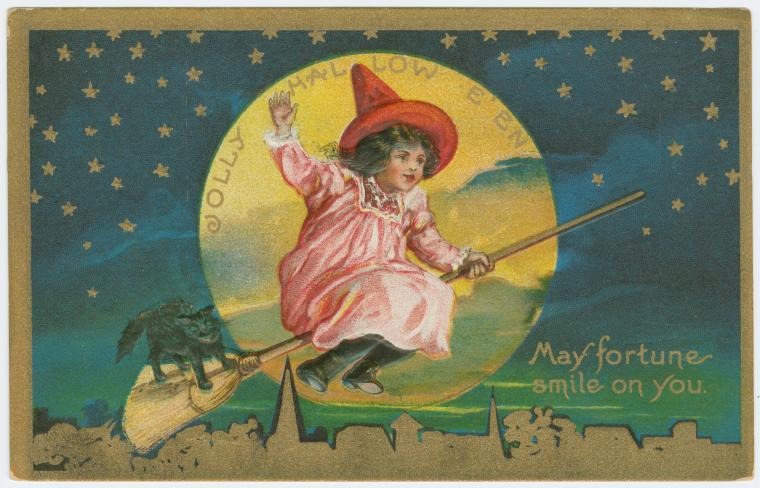
"A Jolly Hallow-e'en" Vintage Postcard, ca. 1910. © NY Public Library Picture Collection.
A fascinating find for Halloween week:

Winifred M. Letts's Hallow-e'en and Poems of the War is widely available online for those of you would like to delve a bit into Halloween and Great War history.

Letts, born in 1882, was of English and Irish heritage. She was also a versatile writer, penning novels, poems, plays, and children's fiction over her career.

The Halloween-themed poems in Letts's collection are touching, rather tragic, musings. They offer an older-world vision of Halloween as a holiday when the spirits of the dead might return to familiar places and people. "Hallow-e'en 1915," for example, is an emotional appeal to the war dead, hoping that they will be drawn by the welcoming lights of home. Hearth fires, stars, lanterns, and lamps are all described as beacons for the "well-beloved dead."

O men of the manor and moated hall and farm
Come back to-night; treading softly over the grass;
The dew of the autumn dusk will not betray where you pass;
The watchful dog may stir in his sleep but he'll raise no hoarse alarm.
--Winifred M. Letts, "Hallow-e'en 1915," (5-8)
Other pieces of note in this great collection are "The Deserter," a well-known piece that considers the plight of those too fearful to fight, and "A Sister in a Military Hospital," about nurses much like those whose uniforms might inspire a costume or two, as I have written previously.

Letts's book connects Halloween to the First World War in an unexpected way, offering a different perspective on the holiday than the one we might know today. In her poems, mingling with ghosts on "Hallow-e'en" is a longed-for reunion rather than a spooky thrill. Most importantly, however, Halloween is for Letts, as it remains today, a time of possibilities, a brief night when real and unreal can come together and a slightly different, more magical, world appears.

© Fiona Robinson

Wednesday, August 15, 2012

The Great War at the Movies

Still from Abel Gance's 1919 J'Accuse. © SF Silent Film Festival Blog
I've been dreaming of the silver screen lately, and I wanted to compile an initial list of essential films about the First World War. There are lots, of course, and many movies feature unexpected links between a primary storyline and the war. Perhaps because I spend so much time reading and writing about the war, these links pop out at me--sometimes surprising me in films I've seen many times before. For instance, the 1992 Chaplin, a favorite of mine for several reasons, includes a phase of the silent star's life when, as he travels in Britain after the war, the relevance of his art is questioned in light of the devastation that his native country has experienced. Chaplin actually made a war "comedy" in 1918, called Shoulder Arms, about which Chris Edwards writes quite eloquently at his blog, Silent Volume. I have not seen the film, but Edwards writes that the Little Tramp character enlists in the American army. Perhaps this alignment, though surely stemming from Chaplin's association with American film studios, allows the film's (strangely chosen) comedy to avoid representational contact with British experience of the war. Though comedy was not an unknown note in this experience or its expression, it is true that the film may strike viewers as odd or somewhat disorienting in its unreal depictions. 

Here are ten films, to start. These are my personal picks for today, not all well-known or widely-recognized as war films, but the ghosts of 1914 haunt them nonetheless. Sometimes the most moving encounters with the Great War on film are not in movies directly about the war, after all. 

1. J'Accuse (1919) Clips from this incredible film can be found here.

2. All Quiet on the Western Front (1930)

3. War Horse (2011)

4. A Very Long Engagement/ Un long dimanche de fiancailles (2004)

5. Chariots of Fire (1981)

6. Paths of Glory (1957)

7. Joyeux Noel (1995)

8. Fairy Tale (A True Story) (1997)

9. Gallipoli (1981)

10. The Englishman Who Went Up a Hill But Came Down a Mountain (1992)

I hope you enjoy watching or remembering some of these films. Take a moment to consider the ways in which the ghosts of 1914 appear in these and other movies--at times manifesting right before our eyes, and at others, hovering at the edges of the screen.

© Fiona Robinson

Saturday, May 19, 2012

The Cat Came Back...

A brief update to yesterday's post about Dick Whittington and his Cat. It seems that, during the Second World War, the 56th London Infantry Division of the British Army adopted Dick Whittington's Cat as their emblem. Uniforms for this division included a small badge with the silhouette of a black cat. There are several examples in the IWM's collections.
Formation Badge, 56th London Infantry Division. © IWM, Item INS 5464

It is interesting to think of the meandering path we've taken on this little exploration of war cats real and mythical. There's something distinctly feline about the twists, turns, and tangents we've covered as we follow Dick Whittington's cat through history, isn't there?

© Fiona Robinson

Wednesday, March 7, 2012

Mods, Rockers, and Ghosts

A musical musing today for my readers: I'm listening to British band The Kinks' brilliant 1969 album Arthur: Or the Decline and Fall of the British Empire as I work on some writing projects this morning. While the entire album is worth a listen or fifty for many reasons, this song struck me as particularly resonant for those of us fascinated by the ghosts of 1914:


Two soldiers fighting in a trench
One soldier glances up to see the sun
And dreams of games he played when he was young
And then his friend calls out his name
It stops his dream and as he turns his head
A second later he is dead
The full lyrics to "Some Mother's Son" are here. 

Another song from the same era is The Zombies' nightmarish "Butcher's Tale (Western Front 1914)," written in 1968. The Guardian's Jon Savage writes about this piece:
"This is a serious song about an extremely serious subject that succeeds because of its restraint and complete synchronicity of form with content, of music with lyric, of feeling with imagination. The Zombies did not experience the western front, but they projected themselves into a terrible event with all the considerable talent at their disposal. "


The Great War and its ghosts certainly do have a lengthy and multifaceted afterlife and it is fascinating to explore the moments and places at which they manifest, even fifty or a hundred years on in time. May the music offer you some food for thought or some accompaniment to your projects today...

© Fiona Robinson