Showing posts with label artists. Show all posts

Friday, June 15, 2012

Dr. Dolittle Goes to War

I once had a conversation with an advisor about the possibility of contracting academic shellshock from researching and writing about war literature. I believe we agreed that it was indeed possible. Truly, it isn't always easy engaging so deeply with the grim and arduous topic of war and its literary expressions. But no grad student would describe any dissertation as a walk in the park. Thus, how much of my occasional academic malaise has to do with war and how much to do with the mere process of writing a dissertation remains a mystery as yet unsolved.

A surprisingly effective remedy came my way this evening, though, from none other than the wonderful Dr. Dolittle. Yes, that Dr. Dolittle, the protagonist of Hugh Lofting's endearing series of children's books, the first of which was published in 1920.

Author Hugh Lofting
My route was circuitous, as usual, but I began by looking for further materials related to service animals in the First World War. I found a veritable menagerie in the IWM's collections database, including reindeer (yes, reindeer), an eagle, pigeons, a lemur, dogs, cats, mules, and horses. And then I found this charming photograph:

Varges Ariel. British Officer of the Army Veterinary Corps in Salonika with his Pets, 1916. © IWM, Item Q 32252.
The British veterinary officer with his jackdaws, goose, dog, and wolf cub seems a veritable Dr. Dolittle, friend to and communicant with all creatures great and small. The photograph made me go hunting for information about the books, which I first encountered in a school library as a child of about eleven.

“'Lord save us!' cried the duck. 'How does it make up its mind?'”  The Story of Dr. Dolittle.

To my surprise, I found that Dr. Dolittle is in fact a ghost of 1914. His creator, English-born, MIT-educated, civil engineer Hugh Lofting (1886-1947), served with the Irish Guards in the First World War. When writing home to his children, Lofting chose to protect them from the gruesome details of trench warfare. Instead, his letters featured the beginnings of the Dr. Dolittle stories. It is amazing to think of the way this fictional character allowed Lofting to create a bit of innocence amid the strife of the battlefield.
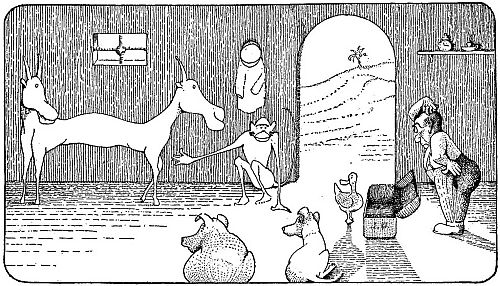
He was very fond of animals and kept many kinds of pets. Besides the gold-fish in the pond at the bottom of his garden, he had rabbits in the pantry, white mice in his piano, a squirrel in the linen closet and a hedgehog in the cellar. He had a cow with a calf too, and an old lame horse—twenty-five years of age—and chickens, and pigeons, and two lambs, and many other animals. But his favorite pets were Dab-Dab the duck, Jip the dog, Gub-Gub the baby pig, Polynesia the parrot, and the owl Too-Too.
--The Story of Dr. Dolittle, p. 3.
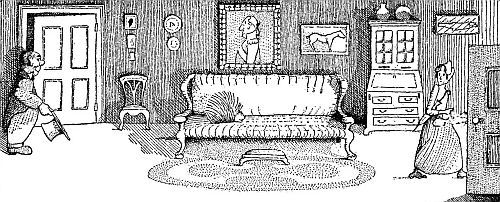
 “And she never came to see him any more” 
(A disgruntled patient leaves after sitting on a hedgehog) The Story of Dr. Dolittle.
Lofting was wounded in the war and eventually moved to Connecticut (my erstwhile home) with his family. In his lifetime, he would write and illustrate twelve books about the eccentric Doctor, who hails from a town called Puddleby-on-the-Marsh and learns to talk with and heal animals and undertakes many amazing adventures with them around the world and beyond. Dr. Dolittle enjoyed several incarnations on the stage and screen and continues to be a beloved hero of fiction.

There are many fantastic web resources on Dr. Dolittle, including full-text (with illustrations!) books on Gutenberg and Google Books. Karen Welbourn's Puddleby-on-the-Marsh website has a treasure trove of information and materials related to Lofting and Dr. Dolittle.

I hope you have enjoyed this lighthearted little jaunt with Dr. Dolittle and me. This merry ghost of 1914 certainly brightened a grad student's day of slogging through the dissertation trenches.

© Fiona Robinson


Friday, May 18, 2012

The Cats of War

Arthur L.F. Cary, "Dick Whittington," 1918. Lithograph. © IWM, Item Art.IWM PST 0555
I love cats (my own beautiful Rosie most of all, naturally). So, I thought that for today's post I would take a look for cat-related items in the IWM's wonderful database. I found the above charming poster of folktale hero Dick Whittington marching to the war with his impressive black cat, helmeted and walking magisterially on hind legs, at his side. Dick looks cheerfully at the viewer, tipping his hat to us as he lugs his considerable load of equipment. The cat, however, keeps eyes forward, pointing his body and gaze ahead of him, focused on their destination.

I must break from Great War talk briefly to mention that I keep thinking of AMC's Mad Men every time I see the name "Dick Whittington." The name sounds much like the real name of the show's 1960s protagonist Don Draper. Don, we eventually learn, is really Dick Whitman, whose name, history, family, and dead-end future he sheds (subsequently claiming the real Don Draper's name and identity from a dead comrade) while serving in the Korean War.
"Don Draper when he was really Dick Whitman." I couldn't have put it better myself, Access Hollywood.
I do hope I haven't ruined any mysteries for Mad Men followers out there, though the Don Draper/Dick Whitman storyline was revealed at least a couple of seasons ago, if not more. I digress, however. This is not a television blog; the bottom line is that: 

Dick Whitman & Dick Whittington=no relation

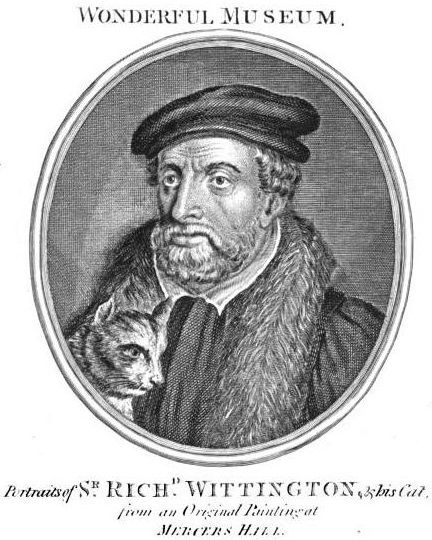
Since we are talking about identities false and true, though, who was the "real" Dick Whittington? The character comes from an old English folk tale loosely based on the true story of Richard Wittington, who served as Lord Mayor of London in the 1300s. Wittington's legend lived on into the twentieth century and came to inspire Arthur Cary to create the poster above in 1918. Having been transformed into a play as early as the seventeenth century and a pantomime stage show in the early 1800s (the first version of which starred the famous clown Joseph Grimaldi), the story of "Dick Whittington and His Cat" was well-known to readers and theater-goers in Britain throughout the nineteenth and into the twentieth centuries.

"Richard Wittington and his Cat," ca. 1790-1820.
Dick Whittington, in his fictional manifestation, is a poor boy who, through the incredible ratting powers of his cat, wins fame and fortune, eventually becoming the mayor of the great city of London. His real counterpart, Richard Whittington, is not known to have had a cat, though a source on Wikipedia speculates that a mistranslation might have led to the appearance of the mythical animal.

A final detail worth pondering in Arthur Cary's poster is the "ET 70" milestone that appears at bottom right. I will assume that this indicates Etaples, the northern French location of a major British base camp. Famously, the Etaples site was the setting for a serious mutiny incident in September, 1917.  Poor morale among troops led to an uprising over the arrest of a soldier from New Zealand. Military police fired into a surging crowd, killing one soldier and wounding a French civilian. Protests ensued and hundreds of men held demonstrations and eventually marched through Etaples over the next few days. When order was forcefully reestablished, punishments including one death sentence, imprisonment, and strippings of rank, were meted out. The Etaples Mutiny was a tragedy all around.

Are Dick Whittington and his cat headed for Etaples? Given the 1918 date of the poster, the Mutiny had surely made some news by the time of Cary's work. It is not clear what the two characters' march towards this location, if this is indeed where they are headed, might mean, though. Perhaps they are simply moving towards the base camp where many British troops were sent before going to the front. Or, are they signalling some solidarity with the frustrated marchers who walked through the town in 1917? A final grim possibility might be that Whittington and the cat are headed to Etaples to enforce order and subdue the spirit of unrest and agitation. No matter their purpose, Whittington appears quite boyish here as he greets us with a confident smile, and though his outfit is of a vaguely military green hue, its clearly antiquated style does not suggest that he is ready for war. His cat, though, seems possessed of a different and thoroughly modern sort of seriousness and motivation.

Herbert Hiller, "'Mowler,' One of Our Mascots," 1915. © IWM, Item Art.IWM ART 4378
The ghosts of 1914 had their allegiances to service animals of many kinds. Horses, dogs, birds, and cats facilitated transportation, communication, safety, and even simply comfort for their human comrades. Herbert Hiller's "Mowler," pictured above, looks quite a lot like Dick Whittington's cat--wise with understanding and intent that we humans can only imagine. This crouching creature, whose glance projects feline accusation as only cats are capable of expressing, reminds us that the war was seen through many eyes and from many perspectives. The actual and the mythical proportions of the conflict, though they shift and startle us even now, take on a new dimension when we consider the feline ghosts of 1914.

© Fiona Robinson


Sunday, January 15, 2012

Rebuilding the Soldier's Body: Plastic Surgery and Prosthetics in WWI

A soldier with a disfiguring injury receives a mask. Anna Coleman Ladd Papers, 1881-1950. Archives of American Art, Smithsonian Institution.
Amid the "dissertissitudes" of life lately (such as working diligently to revise or, to be more accurate, essentially rewrite a dissertation chapter), I have run across a snippet of research that I thought was good for sharing on "Ghosts of 1914." It is on the very fascinating history of plastic surgery and facial prostheses in the aftermath of WWI.

A sculptor or artist at work on a mask. Anna Coleman Ladd Papers, 1881-1950. Archives of American Art, Smithsonian Institution.
Soldiers who were lucky enough to survive the modern killing machines of the Great War were, quite often, injured and/or maimed in significant ways. One of the most devastating sorts of injuries for a veteran was facial disfigurement, something that could significantly challenge his chances at reintegrating into civilian life, whether at home or within his community.

The field of plastic surgery, about which we remain fascinated even as its procedures become increasingly normalized in our culture (for instance, on the big or small screen, it seems near-impossible to find a female--or even, sometimes, a male--forehead not strangely immobilized or eyebrows not fiercely stretched, lips not comically blocky and protruding, etc., etc., etc.), already existed by the time of the Great War. However, the particularly destructive technologies of the war forced the medical field to adapt in major ways to a new set of demands on their aesthetic and surgical abilities, as Smithsonian Magazine's Caroline Alexander writes in a brilliant 2007 article. Where surgery could not fully rebuild a badly-affected face, artists were employed in crafting ingenious prosthetics that could be worn over the damaged feature so as to give the soldier an approximation of his pre-war appearance. In film footage of American artist Anna Coleman Ladd at work from the Smithsonian Magazine website, it looks like plaster casts (like life-masks) of the faces of the injured are used in the process of making a facial prosthesis.  At one moment, we see a soldier demonstrating just such a "mask," worn over his jaw and chin. Another is fitted with a mask that covers part of the upper portion of his face.

Repairing or restoring a soldier's face was not about frivolous vanity or a quest for some sort of ideal beauty. Instead, it had everything to do with restoring a soldier's place on the homefront--with repairing or at least helping to support the bridge between the worlds of combat and civilian life.

© Fiona Robinson
---

Sources and Further Reading: