Showing posts with label soldier. Show all posts

Tuesday, July 24, 2012

"Link Soup": Exciting Finds

For all of you Sassoon enthusiasts, I just wanted to post a link to an amazing exhibition website. "Dream Voices: Siegfried Sassoon, Memory, and War" was held in 2010 at the Cambridge University Library. Though we've missed the chance to see it in person, there is an excellent web exhibition with many wonderful artifacts from the collection and lots of great information:

"Dream Voices: Sassoon, Memory, and War."
http://www.lib.cam.ac.uk/exhibitions/Sassoon/index.html

If you'd like yet more on Sassoon, a 2004 article from The Telegraph discusses his beloved family home, Weirleigh:
"Haunted By the Memories"
http://www.telegraph.co.uk/property/3334004/Haunted-by-the-memories.html

Finally, I ran across this posting from the Library of the Society of Friends, about the papers of Rachel Wilson, a Quaker woman who served as an ambulance nurse during the First World War:
"Rachel Eveline Wilson Papers"
http://librarysocietyfriendsblog.wordpress.com/2012/05/25/rachel-eveline-wilson-papers-and-our-new-exhibition-an-insight-into-the-life-of-a-world-war-i-friends-ambulance-unit-nurse/

I will continue regular posts of "link soup": tidbits that I find in my excursions on the web while doing research. If you'd like to receive soup in smaller, more "real time"-like servings, then follow "Ghosts of 1914" on Twitter, where I post individual findings quite often.

Till next time,
Fiona

Saturday, May 19, 2012

The Cat Came Back...

A brief update to yesterday's post about Dick Whittington and his Cat. It seems that, during the Second World War, the 56th London Infantry Division of the British Army adopted Dick Whittington's Cat as their emblem. Uniforms for this division included a small badge with the silhouette of a black cat. There are several examples in the IWM's collections.
Formation Badge, 56th London Infantry Division. © IWM, Item INS 5464

It is interesting to think of the meandering path we've taken on this little exploration of war cats real and mythical. There's something distinctly feline about the twists, turns, and tangents we've covered as we follow Dick Whittington's cat through history, isn't there?

© Fiona Robinson

Sunday, January 22, 2012

What to Wear to War III: Timepieces for the Trenches

"H. Samuel's War Watches." © IWM, (Art.IWM PST 13687)
As an avid wristwatch collector, I keep an eye on early timepieces that go up for sale here and there on the web and in shops that I visit. I don't have any particularly valuable items myself, but I enjoy looking at (though not being responsible for the upkeep of) vintage watches from the early decades of the twentieth century.

For our ghosts of 1914, wristwatches were important devices. Most people were still making the transition from pocket watches to the newer style worn on the wrist as the 1910s dawned. The below image, from David Boettcher's vintage watch strap website (which contains lots of excellently presented information about the history of military watches), shows one way to transition a pocket watch, worn on a chain at the waist, for wear at the wrist.

A case for converting a pocket watch for wear on the wrist, ca. 1900. ©David Boettcher's vintagewatchstraps.com
A soldier had a particular need for an easily accessible and sturdy timepiece. As the "H. Samuel's" poster from the Imperial War Museum's collections reveals, there were even watches with "luminous dials," so that the time could be told in the dead of night or amid clouds of smoke or dust. Somewhat distressingly, these radiant dials were, quite often, rather literally radiant--painted with radium, an early luminous material for watch faces.

"Telephone Dial" Trench Watch, 1916. antiquewatchcouk.com
In addition to such features as the glow-in-the-dark dials, trench watches sometimes had thick leather bands that wrapped, like a cuff, around the wrist. They also sometimes came with protective metal fixtures, in the shape of a grille, flip-top, or the anachronistically named "telephone dial" style plate, to save the glass watch face from being shattered.

Having access to the time was essential for planned maneuvers and other military operations. Our old friend, war cinematographer Geoffrey Malins, noted in his memoirs the hectic, almost-sickening, sense of anticipation that built as time ticked down to the planned commencement of the Battle of the Somme on 1 July, 1916.
1917 British Military Wristwatch. ©David Boettcher's vintagewatchstraps.com
I'd like to think that having a wristwatch conveyed some sort of sense of normalcy for those on the front, giving them an indication that time was passing and that each minute would bring them nearer to the end of the war and to the moment that they would be reunited with their loved ones at home.  A better, more peaceful, future was only a matter of so many spins round the numbered dial. It might have been just as difficult, however, to watch the hours ticking by on one's wrist, not sure what the coming moments would bring. Great War wristwatches are certainly a fascinating topic, and we will return to this theme another time at "Ghosts of 1914."

© Fiona Robinson

Sunday, January 15, 2012

Rebuilding the Soldier's Body: Plastic Surgery and Prosthetics in WWI

A soldier with a disfiguring injury receives a mask. Anna Coleman Ladd Papers, 1881-1950. Archives of American Art, Smithsonian Institution.
Amid the "dissertissitudes" of life lately (such as working diligently to revise or, to be more accurate, essentially rewrite a dissertation chapter), I have run across a snippet of research that I thought was good for sharing on "Ghosts of 1914." It is on the very fascinating history of plastic surgery and facial prostheses in the aftermath of WWI.

A sculptor or artist at work on a mask. Anna Coleman Ladd Papers, 1881-1950. Archives of American Art, Smithsonian Institution.
Soldiers who were lucky enough to survive the modern killing machines of the Great War were, quite often, injured and/or maimed in significant ways. One of the most devastating sorts of injuries for a veteran was facial disfigurement, something that could significantly challenge his chances at reintegrating into civilian life, whether at home or within his community.

The field of plastic surgery, about which we remain fascinated even as its procedures become increasingly normalized in our culture (for instance, on the big or small screen, it seems near-impossible to find a female--or even, sometimes, a male--forehead not strangely immobilized or eyebrows not fiercely stretched, lips not comically blocky and protruding, etc., etc., etc.), already existed by the time of the Great War. However, the particularly destructive technologies of the war forced the medical field to adapt in major ways to a new set of demands on their aesthetic and surgical abilities, as Smithsonian Magazine's Caroline Alexander writes in a brilliant 2007 article. Where surgery could not fully rebuild a badly-affected face, artists were employed in crafting ingenious prosthetics that could be worn over the damaged feature so as to give the soldier an approximation of his pre-war appearance. In film footage of American artist Anna Coleman Ladd at work from the Smithsonian Magazine website, it looks like plaster casts (like life-masks) of the faces of the injured are used in the process of making a facial prosthesis.  At one moment, we see a soldier demonstrating just such a "mask," worn over his jaw and chin. Another is fitted with a mask that covers part of the upper portion of his face.

Repairing or restoring a soldier's face was not about frivolous vanity or a quest for some sort of ideal beauty. Instead, it had everything to do with restoring a soldier's place on the homefront--with repairing or at least helping to support the bridge between the worlds of combat and civilian life.

© Fiona Robinson
---

Sources and Further Reading:

Thursday, December 8, 2011

What to Get for the Soldier on the Front

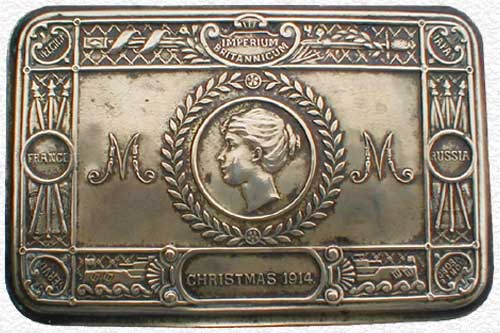
Christmastime is upon us, though we have not had any snow in the last month here in Connecticut and the weather is confusingly blithe. In spite of the friendly temperatures and distinct lack of a need for boots/gloves/hat/scarf at all times, I have begun my Christmas shopping and am doing a bit of holiday crafting each evening. It seems to be time to bring the Yuletide to "Ghosts of 1914," so I thought I would write a bit about the wartime gift meant for everyone in the British Army: The Princess Mary Christmas Gift Box.
The Princess Mary Christmas Gift Box, Village of Kinnethmont, Scotland, website.
James M. Grant's Village of Kinnethmont website has a lovely overview of the Christmas Gift Box's history and contents. According to Grant and other sources, Princess Mary, the daughter of King George V, established a Christmas Gift Fund for soldiers and sailors in November, 1914, to collect contributions towards a present for those on the front. Donations were plentiful, and it was decided that the best present for each soldier or sailor would be a metal box with thoughtful treats and other items. So thoughtful was the gift, in fact, that there was a version for smokers and for non-smokers!

Christmas Box and contents for smokers, © IWM, EPH 1992.

Writing Stationery from a non-smoker's Christmas Box, ©IWM, EPH 2073.
Beyond the differences for smokers and non-smokers, the boxes contained different assortments of items, depending on their recipients. Mr. Dick Elliot, of cigarhistory.info writes about the Gift Box that:
Officers and men on active service afloat or at the front received a box containing a combination of pipe, lighter, 1 oz of tobacco and 20 cigarettes in distinctive yellow monogrammed wrappers. Non-smokers and boys received a sterling silver bullet pencil in a .303 cartridge and a pack of sweets instead. Indian troops often got sweets and spices. Nurses were treated to chocolate. Contrary to opinion, they did not contain cigars. Many of these items were distributed separately from the tins themselves, as once the issue of tobacco and cigarettes was placed in the tin there was little room for much else apart from the greeting card.     
--Dick Elliot, "The Princess Mary Tin"  
In addition to the soldiers and nurses who received the boxes, the families of those who had been killed prior to Christmas, 1914, were also entitled to a tin. Though not every soldier received a box  that year, due to the hazards and complications of delivery during combat, it is a testament to the tins' wide distribution and their sentimental value that the IWM features several (kept by veterans and/or their families and donated to the museum) in their permanent WWI galleries, as I observed when there in June, 2010. The museum's "Women, War, and Society" database also includes many documents relevant to the history of Princess Mary's Fund and the Christmas tins.

The BBC Schools WWI website has an intriguing little interactive feature that includes a Christmas Gift Box among other artifacts that a typical British soldier would have amassed during his service.

Well, we'll close the lid on this little Christmas Box post for now, but we will continue the holiday-themed entries at "Ghosts of 1914." In light of the time of year and perhaps in honor of the ghosts of 1914-1918, I hope that you will consider a holiday contribution of some kind for veterans or soldiers serving today. Until next time, may your days be merry and bright.

© Fiona Robinson