Showing posts with label horse. Show all posts

Wednesday, August 15, 2012

The Great War at the Movies

Still from Abel Gance's 1919 J'Accuse. © SF Silent Film Festival Blog
I've been dreaming of the silver screen lately, and I wanted to compile an initial list of essential films about the First World War. There are lots, of course, and many movies feature unexpected links between a primary storyline and the war. Perhaps because I spend so much time reading and writing about the war, these links pop out at me--sometimes surprising me in films I've seen many times before. For instance, the 1992 Chaplin, a favorite of mine for several reasons, includes a phase of the silent star's life when, as he travels in Britain after the war, the relevance of his art is questioned in light of the devastation that his native country has experienced. Chaplin actually made a war "comedy" in 1918, called Shoulder Arms, about which Chris Edwards writes quite eloquently at his blog, Silent Volume. I have not seen the film, but Edwards writes that the Little Tramp character enlists in the American army. Perhaps this alignment, though surely stemming from Chaplin's association with American film studios, allows the film's (strangely chosen) comedy to avoid representational contact with British experience of the war. Though comedy was not an unknown note in this experience or its expression, it is true that the film may strike viewers as odd or somewhat disorienting in its unreal depictions. 

Here are ten films, to start. These are my personal picks for today, not all well-known or widely-recognized as war films, but the ghosts of 1914 haunt them nonetheless. Sometimes the most moving encounters with the Great War on film are not in movies directly about the war, after all. 

1. J'Accuse (1919) Clips from this incredible film can be found here.

2. All Quiet on the Western Front (1930)

3. War Horse (2011)

4. A Very Long Engagement/ Un long dimanche de fiancailles (2004)

5. Chariots of Fire (1981)

6. Paths of Glory (1957)

7. Joyeux Noel (1995)

8. Fairy Tale (A True Story) (1997)

9. Gallipoli (1981)

10. The Englishman Who Went Up a Hill But Came Down a Mountain (1992)

I hope you enjoy watching or remembering some of these films. Take a moment to consider the ways in which the ghosts of 1914 appear in these and other movies--at times manifesting right before our eyes, and at others, hovering at the edges of the screen.

© Fiona Robinson

Wednesday, June 6, 2012

The Imperial Camel Corps

My apologies to my readers for a brief hiatus over the past couple of weeks. A number of things--vicissitudes and dissertissitudes--have made for little blogging time recently. Today, though, I wanted to share with you a wonderful, unexpected, artifact and some of the fascinating history that came with it. In so doing, we will continue our exploration of service animals in WWI, having previously considered the histories of cats and, to a small extent, horses. Whilst looking through the IWM's collections database for a couple of different blog-worthy items (related to tea-making and souvenir-taking on the front), I came, circuitously, across this magazine:

Barrak: The  Camel Corps Review, 1 Sept 1917. Cairo. © IWM, Item Documents.9964
Not only was there an Imperial Camel Corps during the First World War, but there was also a periodical, entitled Barrak, dedicated thereto, as you can see from the example above. The Corps was started in January, 1916, and served on fronts in the Middle East. It was not, you may be surprised to find, the first camel-mounted British military unit. The Imperial's predecessor, the Somaliland Camel Corps, was initiated in 1912, and endured until 1944. A colonial protectorate with ties to their imperial holdings in India, British Somaliland, part of present-day Somalia, was under British rule from the 1880s to 1960, except for a brief period of occupation by Italy in the 1940s. The Somaliland Camel Corps enforced British governance of the protectorate. Its numbers were largest during its earlier phase, with up to 700 riders fighting rebels in the area during the Great War years.

Though the Somaliland Camel Corps bears its own fascinating history, we are here today to explore the Imperial Camel Corps, founded specifically for service in the Middle East during the First World War. Pro-Turkish tribespeople began to revolt in Egypt in 1916, and the Corps (known as the ICC) was organized to quell this rebellion, according to the Australian War Memorial's excellent web page on the ICC. ICC troops were enlisted primarily from Australia, New Zealand, and Britain, with Indian soldiers later joining their ranks. With the shift from patrol to combat in Egypt, the ICC was reorganized into the Imperial Camel Corps Brigade by the close of 1916. Four battalions within the brigade were established by 1917, and with the addition of the Hong Kong and Singapore Mountain Battery, as well as a machine gun squadron, Field Ambulances and medical support for soldiers and camels, and a Royal Engineer Troop, among other supports, the ICC Brigade became a formidable military force. For those who want to know more, New Zealand History Online has a great article on the organization of the ICC.

Hong Kong and Singapore Mountain Battery troops training. Australian War Memorial, Item B01465.


Australian Camel Company, ca 1914-18.

Camels were considered an ideal service animal for the Middle Eastern front, as they were naturally adapted for the terrain and climate. The camels who served in the ICC were initially brought in from the north Indian district of Bikaner. This princely state had its own camel-mounted unit, known as the Bikaner Camel Corps, whose Imperial Service Troops also fought for the British Army in Egypt.

Bikaner Camel Corps in Egypt, ca 1914-18.
Camels are sturdy animals, and both the Indian and the Egyptian camels who also served in the Corps were able to carry soldiers and their equipment at an impressive clip in the desert sands. They also managed to remain calmer in combat situations than their equine counterparts. Typically, camels would transport men, sometimes known as cameliers or cameleers, and goods, with troops dismounting to engage in artillery combat.  The Australian War Memorial's collection database has an extraordinary assortment of objects and media representing life in the ICC.

George Lambert. Camel, Abbassia, full marching order. 1918. © Australian War Memorial. Item ART02744
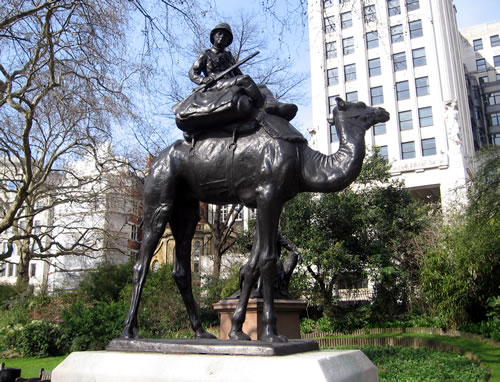
The ICC Brigade served gallantly in Egypt and Palestine through to Armistice. Combat in Palestine began to necessitate transition for Australian and New Zealand troops of the ICC, who were moved into horse-mounted battalions. Notably, near the end of the war, two of the British battalions who had remained in the Brigade played an important role in the Arab Revolt, alongside T.E. Lawrence ("Lawrence of Arabia"). By the time of the ICC's complete disbanding in May, 1919, nearly two hundred fifty casualties had been sustained among its British, New Zealander, Australian, and Indian members. A memorial to the Imperial Camel Corps was installed at Victoria Gardens, London, in 1921.

ICC Memorial, © New Zealand History
The mounted soldier and his camel are startling and somewhat poignantly situated in the verdant park, especially against the backdrop of modern skyscrapers as shown above. They seem to pause amid a long and arduous journey from a world far away, reminding us that the ghosts of 1914 hail from many reaches of the globe and represent a much stranger, more curious, set of histories than we may initially assume.

© Fiona Robinson


Friday, May 18, 2012

The Cats of War

Arthur L.F. Cary, "Dick Whittington," 1918. Lithograph. © IWM, Item Art.IWM PST 0555
I love cats (my own beautiful Rosie most of all, naturally). So, I thought that for today's post I would take a look for cat-related items in the IWM's wonderful database. I found the above charming poster of folktale hero Dick Whittington marching to the war with his impressive black cat, helmeted and walking magisterially on hind legs, at his side. Dick looks cheerfully at the viewer, tipping his hat to us as he lugs his considerable load of equipment. The cat, however, keeps eyes forward, pointing his body and gaze ahead of him, focused on their destination.

I must break from Great War talk briefly to mention that I keep thinking of AMC's Mad Men every time I see the name "Dick Whittington." The name sounds much like the real name of the show's 1960s protagonist Don Draper. Don, we eventually learn, is really Dick Whitman, whose name, history, family, and dead-end future he sheds (subsequently claiming the real Don Draper's name and identity from a dead comrade) while serving in the Korean War.
"Don Draper when he was really Dick Whitman." I couldn't have put it better myself, Access Hollywood.
I do hope I haven't ruined any mysteries for Mad Men followers out there, though the Don Draper/Dick Whitman storyline was revealed at least a couple of seasons ago, if not more. I digress, however. This is not a television blog; the bottom line is that: 

Dick Whitman & Dick Whittington=no relation

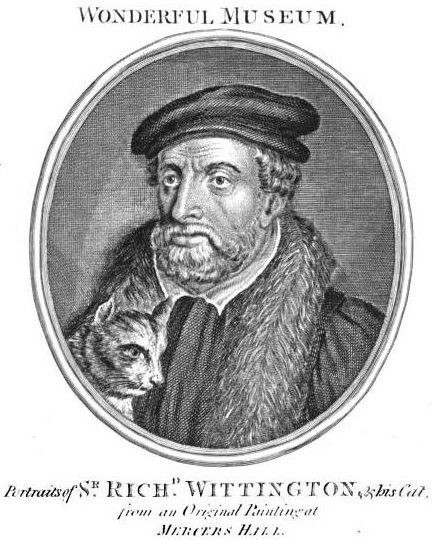
Since we are talking about identities false and true, though, who was the "real" Dick Whittington? The character comes from an old English folk tale loosely based on the true story of Richard Wittington, who served as Lord Mayor of London in the 1300s. Wittington's legend lived on into the twentieth century and came to inspire Arthur Cary to create the poster above in 1918. Having been transformed into a play as early as the seventeenth century and a pantomime stage show in the early 1800s (the first version of which starred the famous clown Joseph Grimaldi), the story of "Dick Whittington and His Cat" was well-known to readers and theater-goers in Britain throughout the nineteenth and into the twentieth centuries.

"Richard Wittington and his Cat," ca. 1790-1820.
Dick Whittington, in his fictional manifestation, is a poor boy who, through the incredible ratting powers of his cat, wins fame and fortune, eventually becoming the mayor of the great city of London. His real counterpart, Richard Whittington, is not known to have had a cat, though a source on Wikipedia speculates that a mistranslation might have led to the appearance of the mythical animal.

A final detail worth pondering in Arthur Cary's poster is the "ET 70" milestone that appears at bottom right. I will assume that this indicates Etaples, the northern French location of a major British base camp. Famously, the Etaples site was the setting for a serious mutiny incident in September, 1917.  Poor morale among troops led to an uprising over the arrest of a soldier from New Zealand. Military police fired into a surging crowd, killing one soldier and wounding a French civilian. Protests ensued and hundreds of men held demonstrations and eventually marched through Etaples over the next few days. When order was forcefully reestablished, punishments including one death sentence, imprisonment, and strippings of rank, were meted out. The Etaples Mutiny was a tragedy all around.

Are Dick Whittington and his cat headed for Etaples? Given the 1918 date of the poster, the Mutiny had surely made some news by the time of Cary's work. It is not clear what the two characters' march towards this location, if this is indeed where they are headed, might mean, though. Perhaps they are simply moving towards the base camp where many British troops were sent before going to the front. Or, are they signalling some solidarity with the frustrated marchers who walked through the town in 1917? A final grim possibility might be that Whittington and the cat are headed to Etaples to enforce order and subdue the spirit of unrest and agitation. No matter their purpose, Whittington appears quite boyish here as he greets us with a confident smile, and though his outfit is of a vaguely military green hue, its clearly antiquated style does not suggest that he is ready for war. His cat, though, seems possessed of a different and thoroughly modern sort of seriousness and motivation.

Herbert Hiller, "'Mowler,' One of Our Mascots," 1915. © IWM, Item Art.IWM ART 4378
The ghosts of 1914 had their allegiances to service animals of many kinds. Horses, dogs, birds, and cats facilitated transportation, communication, safety, and even simply comfort for their human comrades. Herbert Hiller's "Mowler," pictured above, looks quite a lot like Dick Whittington's cat--wise with understanding and intent that we humans can only imagine. This crouching creature, whose glance projects feline accusation as only cats are capable of expressing, reminds us that the war was seen through many eyes and from many perspectives. The actual and the mythical proportions of the conflict, though they shift and startle us even now, take on a new dimension when we consider the feline ghosts of 1914.

© Fiona Robinson


Thursday, May 3, 2012

What to Wear to War/India in Flanders Field: The Color of Khaki

Hello, friends. I am musing these days on the color of khaki. One of the most striking and pleasingly historically accurate scenes in the recent film War Horse (which was great, by the way, and upon which I shall comment post-haste) was one in which a group of officers stands before the camera. Modern viewers might be surprised by the veritable spectrum of colors that they wear--olive, moss, tan, bottle green. Uniforms are supposed to be uniform, after all, aren't they? If we explore a bit, however, we find that khaki--which today might conjure up only images of dull cotton trousers sold in mass quantities by major clothing chains--has a fascinatingly, insistently, diverse identity and history.
A scene from War Horse, from The Telegraph's media archive.
The Oxford English Dictionary defines "khaki" as "Dust-coloured; dull brownish yellow, drab." The term appeared and evolved in the mid-nineteenth century, taking its roots in British Imperialist conflict/conquests in India. Early periodicals and publications describe troops "dressed in khakee [sic]," linking the shade closely to the color of dust or mud. Khaki, as it came to be spelled over the later Victorian period, was made in India, and the OED's citations of the term suggest that one of its most hallmark features was, paradoxically, its variation. An 1890s reference book on Indian products comments, in fact, somewhat desultorily, "It is needless to attempt an enumeration of all the Khaki dyes of India."

Writer Viju Mangalore has an interesting and detailed article about the history of khaki production in India, noting its roots in the southwestern city of Mangalore. The Met Museum also has a useful overview of Indian textiles made for trade.

Wikipedia notes that khaki was adopted as a uniform material and color after the 1840s; the cloth was linen or cotton, and its color came from mulberry dye. The British Army used khaki uniforms, according to Wikipedia, for foreign campaigns in the 1890s, with a more greenish, darker, shade becoming typical for "home service dress," after the turn of the twentieth century.

"Why Aren't YOU in Khaki?" poster, 1915. © IWM (Art.IWM PST 5153) 
The color of khaki continued to defy conformity into the First World War. As my current dissertation research subject, Siegfried Sassoon, writes in his semi-autobiographical Memoirs of a Fox-Hunting Man and the subsequent Memoirs of an Infantry Officer, Army officers ordered their uniforms from tailors. The tailor's ability to locate the proper shade of khaki, however, was as varied as the cloth itself. Sassoon's fictional alter-ego notes that one man's "shirt and tie were more yellow than khaki" (MFHM, 260) and, later, that a Brigadier is a source of annoyance because of his "light-colored shirt" (MIO, 34). Variation clearly continued to dog the military leaders who sought uniformity during the Great War. 

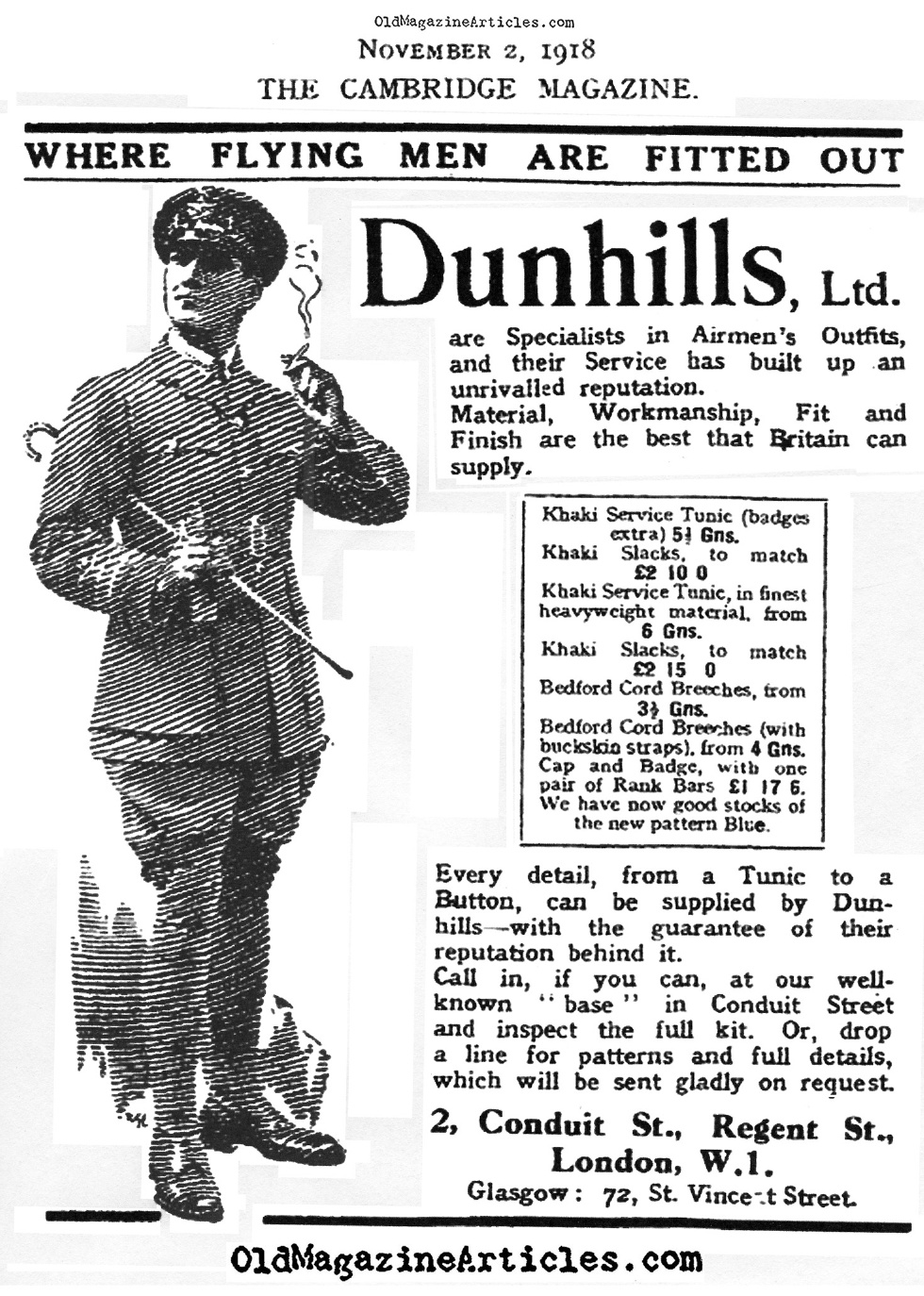
Barely more than a week before Armistice, Dunhills Tailoring offers uniforms for "Flying Men."
Though the color of khaki cloth is defined in dictionaries and military manuals, its real, material, form was widely varied for our ghosts of 1914. I enjoy this paradox--the appointed uniform color that refuses uniformity. Surely, however, for most soldiers and officers, the mud and dust of the trenches came to cloak that individuality with the grim evidence of service and suffering on the front. Though he notes the confounding multiplicity of khaki in his prose, Sassoon also wrote, in verse published in the 1918 collection, Counter-Attack and Other Poems of "the plastering slime," and "the sucking mud," finding, in these and other phrases, numerous ways of conveying the oppressive conditions of the trenches and battle zones, as though the mud there was active, destructive, covering over all traces of individuality, of life.

I hope that this musing allows you to consider the color of khaki--what it means to us today and what it has meant over its long history, to people in many places around the world. It is far more than just a uniform shade.

© Fiona Robinson


Wednesday, December 21, 2011

At the Movies: War Horse

I am eagerly anticipating the premiere of War Horse!

Still from War Horse, 2011.

One of the highlights of my 2010 trip to England was watching the stage adaptation of Michael Morpurgo's beautiful 1982 novel. It was breathtaking to see the life-size horse puppets prance, rear up, and gallop around the stage during the production in the West End. I couldn't believe how much emotion they (and their amazing puppeteers) were able to draw out from the audience. It was one of the most vivid examples of the sort of investment--that feeling of being gathered into, enfolded within, drawn to grant one's care and attention to something--that great drama and great literature can inspire in us.


I will be waiting (patiently!) to see the film version when it debuts here in the U.S. Regardless of the film's living up to my high hopes, though, my encounter with War Horse on the page and on the stage has been a fascinating one and I highly recommend the book and the play. They both illuminate the role of animals who served in the Great War--a deeply important aspect of the history of this conflict and one to which I will return in later posts.

© Fiona Robinson