Showing posts with label peace. Show all posts

Monday, July 30, 2012

Olympic Spirit

A largely musing post today to consider the Olympics, as the 2012 London Summer Games are underway.

Not being a subscriber to cable television and sadly unable to obtain a digital signal for the local station's broadcast (few in my region of the San Francisco Bay Area are able to do so), I've been more or less out of the loop on the 2012 Olympics so far, with the exception of newspaper articles, a fleeting glimpse of the Opening Ceremonies online, and a bit of time spent watching swimming and gymnastics events with family last night.

What I love about the Olympics is the ideal of common humanity and the celebration of athleticism in so many forms that the Games bring us every four years in Winter and Summer.  

For our ghosts of 1914, there were no Olympic Games during the war. After 1912's Games in Stockholm, Sweden, the 1916 Olympics, which had been scheduled prior to the war to take place in Berlin, Germany, were cancelled. The war cast a huge shadow over the Games, one that did not lift until the 1920 Antwerp, Belgium Summer Olympics. This Olympiad was awarded to the war-torn city as a way of initiating a healing process after Armistice. However, it appears that considerable tension remained, and several nations (including Germany, Austria, Bulgaria, and Turkey) were not invited to participate. 

On a lighter note, I found that the 1920 Games included medals for Tug-of-War, which I had not previously realized was an Olympic sport! Tug-of-War lasted from 1900-1920 at the Olympics.

The Swedish Team engaged in Tug-of-War at the 1920 Games.  © Getty Images

Thinking about the Olympics as having some healing power after the international crisis of the First World War brings to my mind one of my (top two or three) favorite films: 1981's Chariots of Fire (for interested parties, the film has been re-mastered and re-released in time for the 2012 Games). Depicting the story of the British runners who went to the 1924 Paris Olympics, this film captures one of many pivotal moments in Olympic history. Chariots of Fire opens with scenes of solemn memorial--a contemporary funeral service gives way to memories of 1920s Cambridge, where young men just entering the University pay homage to other young Cambridge men, just a few years older than themselves, who have died in the war. Another sequence shows us two war veterans, one with an extensive facial prosthetic, helping two future members of the Olympic team into a cab as they arrive to begin their University education. The two veterans look resentfully at their only slightly younger peers, considering the toll they have paid so that these more privileged (both in age and presumably in financial status) men can enjoy the civilian life, saved by time and circumstance from the realities of the Front.
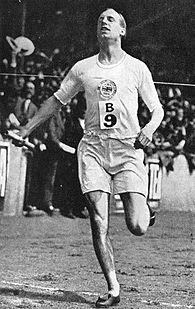
Eric Liddell at the 1924 Games.
While it recognizes the still-painful historical context of a post-war Olympiad, Chariots of Fire celebrates the more universal Olympic ideals of athleticism, teamwork, and personal triumph over various challenges. When we watch the runners sprinting around the track or racing along a windy beach, there is something compellingly pure about their movement and their engagement with their sport--it is as though nothing else exists and nothing else matters. 

Harold Abrahams, ca 1924.
Of course, it is not the case that nothing else really matters or exists--this is not the reality that the Olympics, or a film like Chariots of Fire, reflect. Rather, they offer an important reminder that, in spite of all else that does matter and affect us, in our daily lives or on a global scale, transcendence is possible. Regardless of our personal athleticism (or our possession or lack of a cable television subscription), we all have access to this truth.

© Fiona Robinson

Tuesday, June 26, 2012

Raise the Flag: Semaphore Signaling for War and Peace

Horace Nicholls. Girl Guides Practicing Semaphore Signaling, ca. 1914-18.© IWM, Item Q30965
I ran across this photograph of young women practicing semaphore signaling in a random search of the IWM's collections database. The two Girl Guides (whose scouting organization had been founded in 1910 by Robert Baden-Powell) seem quite serious about their enterprise, and for good reason. 


British semaphore signal flags, undated.  © IWM, Item FLA 849
Semaphore signaling was an important method of communication. A simple way of transmitting information at a distance, it originated in the late eighteenth century and came to have many uses. For instance, railroads were known to use semaphore signaling to control train traffic and ensure safety. The essential component of the system is the use of movable arms (above demonstrated quite literally) to hoist signal flags. According to a 1918 encyclopedia entry on signaling, the British Navy used a system of seven positions. An entire alphabet could be signaled depending on the positioning of the flags. The system is still used today, though much more rarely than it once was.

Semaphore Alphabet, from Capt. E.J. Solano's book, Signalling, 1918.

Women practicing semaphore signaling at a summer camp, Hertsfordshire, 1916.  © IWM, Item Q 108031
Women young and older clearly took an interest in semaphore signaling on the Great War homefront, as the two fascinating photos from the IWM's collection show us. Signaling officers on the battlefields, like the young man who once owned the set of instructional cards below, used semaphore signals to communicate important information during combat.
"Semaphore Signaling in a Week" instructional card set, ca. 1916. © IWM, Item EPH 2507
A British Pathe film from the war era shows multiple women demonstrating semaphore flag signaling at  an unknown location. Such evidence suggests that women's war efforts included the learning of the semaphore system as a way of mobilizing the homefront, of being prepared for emergency communications, should other, more technologically dependent, methods become unavailable.

Fascinatingly, an anti-war symbol that we all recognize is based on semaphore signals. As an informative BBC News article details, the peace sign was developed by Gerald Holtom, a conscientious objector during World War Two. His symbol debuted in the 1950s at a British protest demanding nuclear disarmament. The semaphore signals for "N" and "D," when combined, create the iconic image:

"Decoding the Logo," BBC News Magazine.
The artifacts we have here show us that semaphore signals were an essential part of information transmission on the battlefield and a part of women's homefront service during the Great War. The semaphore system, with its instructional silhouetted figures gripping flags or photographs of eager young people practicing with arms held aloft, is one example of  communication, already heavily electronically mediated by the time of the war, remaining human--conveying important military messages, homefront anxieties, and, eventually, hopes for a more peaceful world.

© Fiona Robinson

Thursday, May 10, 2012

Sassoon's Separate Peace

Siegfried Sassoon, 1916. © National Portrait Gallery, London. Item NPG x 144195
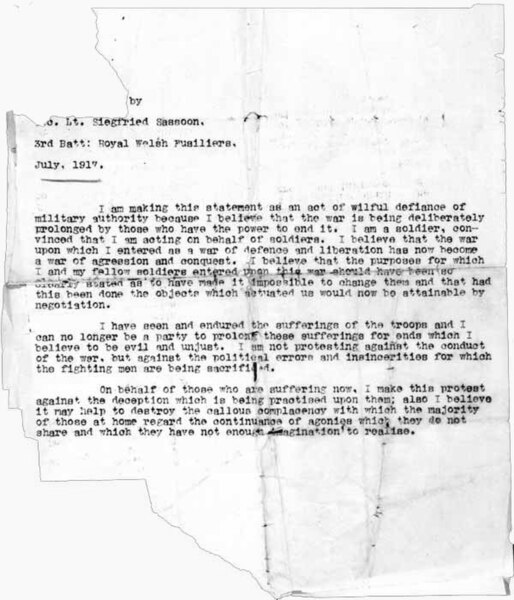
Siegfried Sassoon (1886-1967) made a bold decision in the summer of 1917. As he records it in his Memoirs of an Infantry Officer, his recovery from a bullet wound received on the front after three long years of service allowed him time to formulate a statement of his feelings on the seemingly endless war. With the support of pacifist friends, he put pen to paper. Sassoon writes of this moment as one at which he reconsidered his relationship to the conflict, reclaiming his right, as an individual, to secede from the collective sentiments of patriotism or glory or duty that had encouraged so many to enlist and so many others to remain complacent about the events and costs of what was happening 'over there.' Here, from his memoirs, is that statement--an incredible declaration of individual feeling, agency, and integrity:

I am making this statement as an act of wilful defiance of military authority, because I believe that the War is being deliberately prolonged by those who have the power to end it. I am a soldier, convinced that I am acting on behalf of soldiers. I believe that this War, upon which I entered as a war of defence and liberation, has now become a war of aggression and conquest. I believe that the purposes for which I and my fellow soldiers entered upon this War should have been so clearly stated so as to have made it impossible to change them, and that, had this been done, the objects which actuated us would now be attainable by negotiation. I have seen and endured the sufferings of the troops, and I can no longer be a party to prolong the sufferings for ends which I believe to be evil and unjust. I am not protesting against the conduct of the War, but against the political errors and insincerities for which the fighting men are being sacrificed. On behalf of those who are suffering now I make this protest against the deception which is being practised on them; also I believe I may help to destroy the callous complacency with which the majority of those at home regard the continuance of agonies which they do not share, and which they have not sufficient imagination to realize.                              
 Memoirs of an Infantry Officer, 207
"Finished with the War: A Soldier's Declaration."
Sassoon's statement as read to the House of Commons and printed in the London Times.
Sassoon's declaration incited quite a lot of turmoil. Because of his distinguished service record, he had earned considerable respect in the Army. He was offered the chance to recant, but refused. Facing a court martial and likely imprisonment, a decision was made to allow a medical board to declare him mentally unfit for service. Sassoon was sent to Craiglockhart Hospital in Scotland, where he remained for a number of months. There, he met not only the incomparable Dr. W.H.R. Rivers  but also Wilfred Owen--a younger poet of dazzling talent. Owens would be killed in action just before Armistice. Together, Owen and Sassoon published poetry in the Hospital's own periodical, The Hydra.
The Hydra, 12th May 1917. © University of Oxford, First World War Poetry Digital Archive
There is so much to read and learn about Sassoon and his incredible act of defiance. For those wishing to know more, Sassoon's memoirs are a good place to start. Pat Barker's trilogy of war novels, which begin with Regeneration, include a fictionalized account of Sassoon and Owen at Craiglockhart. An invaluable resource is also found in Oxford University's First World War Poetry Digital Archive, which contains multitudes--of documents, images, and other media related to personal histories of the war. The Peace Pledge Union Project, a British pacifist organization, also has an informative set of resources about Sassoon.

Take a moment to read Sassoon's statement and consider it both within and beyond its Great War framework. The words of this ghost of 1914 remain relevant and affecting. They devastate and inspire us with their insistence on the truths about national events or enterprises that are revealed through individual experience and testament. 

© Fiona Robinson

Tuesday, December 20, 2011

Ghosts of Christmas 1914

A British officer's photo of soldiers meeting during the Christmas Truce of 1914. © IWM, Item Q 11718.

Greetings, readers. Happy Hanukkah to those of you celebrating the first day of the holiday! Today, I wanted to write about a singular event during World War One: the Christmas Truce of 1914. Though it was for a time regarded as a rumor or myth, this remarkable event really happened and is well-documented in written and visual records. On various stretches of the front lines, a truce in honor of the holiday was called, informally, between British and German soldiers. It lasted roughly from December 25, 1914 to January 3, 1915. What I find so compelling about it, as many others do, is that in the midst of a brutal combat, soldiers on opposing sides could choose to put down their weapons and interact in a spirit of brotherhood and goodwill. What an amazing thing that our ghosts of 1914 did during those several wintry days on the battlefield! 

Soldiers from the British and German armies gathered to play games, exchange various souvenirs, and, poignantly, to bury comrades fallen in previous days of fighting. There are some incredible photographs artifacts related to these events in the Imperial War Museum's (IWM's) collection:
British and German officers meeting during the Christmas Truce, 1914. ©IWM, Item Q 50721

German Bierstein given to Pte. Bill Tucker in honor of winning a Christmas football match. ©IWM, Item EPH 3147

For those of you wanting to research the Christmas Truce, the village of Kinnethmont website has a stellar description of the event, with artifacts. Wikipedia's "Christmas Truce" entry notes that a memorial to the truce was dedicated in 2008, with descendants of soldiers from both armies participating in its commemoration. The Guardian also has a nice, brief, selection of first-hand accounts of the truce. Use the keywords "Christmas Truce" to search the IWM collections database, and you'll discover many artifacts and manuscript items. The 2005 French film, Joyeux Noel, looks at the truce from the perspective of various soldiers.

The temporary embrace of peace was both miracle and tragedy--that it was possible, even for such a brief time, made it all the more heartbreaking that it was abandoned and combat resumed once again. However, that soldiers were able to set aside differences of all kinds and relate to one another as people did much to destabilize nationalistic sentiment on both sides. In fact, so potentially threatening to the war were these several days of peace that both sides' armies resolved that there would be no repetition of the Christmas Truce in subsequent years. War offices also worked to repress the truth about the truce, such that it was regarded as only the stuff of legend for some time afterward.

Until the next time we visit the Ghosts of 1914 and of Christmases past, I wish you all a very happy and peaceful holiday.

© Fiona Robinson