Showing posts with label christmas. Show all posts

Thursday, December 20, 2012

Christmas Across the Great Divides

Weee!
A soldier on leave at Epsom, 1914. © IWM, Item Q 53560.

It's December 19th and Christmas is less than a week away! Last year at this point, I was writing about the famous 1914 Christmas Truce and about gifts for soldiers, like the Princess Mary's Gift Box. Both of these phenomena reflect the crossing of significant barriers or divides, whether that which lay between one side and the other on the battlefield or between home and front. A wartime Christmas mediated such boundaries in many ways. Christmas was a time to set aside differences, in the case of the truce, which was said to involve games of football, solemn reflections, and food and gift exchanges. It was also a particularly meaningful time for civilians to connect with troops.

The poster above suggests a pipe or a pouch of tobacco as a gift for a soldier, urging the shopper to make the purchase as a safeguard against forgetting a serviceperson altogether (a sad and hopefully unlikely possibility). Below, the so-called "Sheffield Telegraph" Fund was a safeguard against the absence of Christmas puddings for soldiers:

"Christmas Puddings for Soldiers and Sailors," ca. 1914-18.  © IWM, Item PST 10793.

The soldiers who would have received such treats from home were not so lucky as to have been granted leave for the holiday (like their sledding comrade in the first image here). However, these men would have celebrated the holidays in as merry a fashion possible. Photographs from the IWM's collections database suggest that every effort was made to mark the occasion, even in the harshest of conditions:

Christmas dinner in a shell-hole, 1916. © IWM, Item Q1630.

I can't tell whether the group in the above photo are dining in the company of a grave (marked by the mound of gravel and wooden cross?). It certainly appears so. As I noted in my previous post about wartime theatre, many festivities on the front had to confront severe circumstances or limitations in achieving their various illusions. Regardless of whether my suspicion about the photo here is correct, the soldiers pictured are participating in a kind of theater of their own, replicating as closely as possible a festive meal shared between loved ones who are gathered specially for the occasion. Given the grim necessity of eating a surely modest supper whilst assembled in a blasted crater and possibly in the company of a dead comrade, the distance between the real and the imagined or fancifully replicated is clear, though the effort to bridge this divide is moving.

That the men keep their helmets on throughout this meal suggests that while their meal may represent a respite from the everyday reality of war, very serious danger persists. It is possible, of course, that there is no attempt to erase the battlefield here. The soldiers may well be embracing their prevailing reality (especially given their chronologically and psychologically entrenched position in the disastrous midle years of the war), with the nod to holiday tradition a somewhat farcical performance that can only highlight the impossible distance between themselves and a pre-war era or a civilian world.

Back at home, civilians seeking a bit of festive escape from the everyday might have attended the "Christmas in Wartime" event:
"Christmas in Wartime," ca. 1915. © IWM, Item PST 1074.
A khaki-clad Father Christmas sits atop the great performance venue in this poster, welcoming all to attend the fundraising event, though also reminding them of the war's heavy burden on the nation, especially at the holidays. Whether at home or on the front, Britons were well aware of Christmas's symbolic power, which in no small way was/is tied to its theatricality--its ability to represent and permit the kind of joy, peace, or communal celebration that we wish for all year round. Our participation in Christmas festivities is a way of participating in a performance--an enactment of the happy things that we want to be true or real on more than just one day out of every three hundred sixty-five (which might explain my need to set up our Christmas tree and start listening to holiday music right after Thanksgiving this year!). Nearly a century ago, our ghosts of 1914 must have longed for the normalcy of Christmas's usual illusions. Their attempts to cross the divides of war and home or wartime and peacetime evince these heartfelt holiday wishes.

I hope you've enjoyed this first set of images and musings under our Great War Christmas tree this year. I'll be back with more holiday goodies leading up to the big day next week!

© Fiona Robinson


Wednesday, December 21, 2011

At the Movies: War Horse

I am eagerly anticipating the premiere of War Horse!

Still from War Horse, 2011.

One of the highlights of my 2010 trip to England was watching the stage adaptation of Michael Morpurgo's beautiful 1982 novel. It was breathtaking to see the life-size horse puppets prance, rear up, and gallop around the stage during the production in the West End. I couldn't believe how much emotion they (and their amazing puppeteers) were able to draw out from the audience. It was one of the most vivid examples of the sort of investment--that feeling of being gathered into, enfolded within, drawn to grant one's care and attention to something--that great drama and great literature can inspire in us.


I will be waiting (patiently!) to see the film version when it debuts here in the U.S. Regardless of the film's living up to my high hopes, though, my encounter with War Horse on the page and on the stage has been a fascinating one and I highly recommend the book and the play. They both illuminate the role of animals who served in the Great War--a deeply important aspect of the history of this conflict and one to which I will return in later posts.

© Fiona Robinson

Tuesday, December 20, 2011

Ghosts of Christmas 1914

A British officer's photo of soldiers meeting during the Christmas Truce of 1914. © IWM, Item Q 11718.

Greetings, readers. Happy Hanukkah to those of you celebrating the first day of the holiday! Today, I wanted to write about a singular event during World War One: the Christmas Truce of 1914. Though it was for a time regarded as a rumor or myth, this remarkable event really happened and is well-documented in written and visual records. On various stretches of the front lines, a truce in honor of the holiday was called, informally, between British and German soldiers. It lasted roughly from December 25, 1914 to January 3, 1915. What I find so compelling about it, as many others do, is that in the midst of a brutal combat, soldiers on opposing sides could choose to put down their weapons and interact in a spirit of brotherhood and goodwill. What an amazing thing that our ghosts of 1914 did during those several wintry days on the battlefield! 

Soldiers from the British and German armies gathered to play games, exchange various souvenirs, and, poignantly, to bury comrades fallen in previous days of fighting. There are some incredible photographs artifacts related to these events in the Imperial War Museum's (IWM's) collection:
British and German officers meeting during the Christmas Truce, 1914. ©IWM, Item Q 50721

German Bierstein given to Pte. Bill Tucker in honor of winning a Christmas football match. ©IWM, Item EPH 3147

For those of you wanting to research the Christmas Truce, the village of Kinnethmont website has a stellar description of the event, with artifacts. Wikipedia's "Christmas Truce" entry notes that a memorial to the truce was dedicated in 2008, with descendants of soldiers from both armies participating in its commemoration. The Guardian also has a nice, brief, selection of first-hand accounts of the truce. Use the keywords "Christmas Truce" to search the IWM collections database, and you'll discover many artifacts and manuscript items. The 2005 French film, Joyeux Noel, looks at the truce from the perspective of various soldiers.

The temporary embrace of peace was both miracle and tragedy--that it was possible, even for such a brief time, made it all the more heartbreaking that it was abandoned and combat resumed once again. However, that soldiers were able to set aside differences of all kinds and relate to one another as people did much to destabilize nationalistic sentiment on both sides. In fact, so potentially threatening to the war were these several days of peace that both sides' armies resolved that there would be no repetition of the Christmas Truce in subsequent years. War offices also worked to repress the truth about the truce, such that it was regarded as only the stuff of legend for some time afterward.

Until the next time we visit the Ghosts of 1914 and of Christmases past, I wish you all a very happy and peaceful holiday.

© Fiona Robinson

Thursday, December 8, 2011

What to Get for the Soldier on the Front

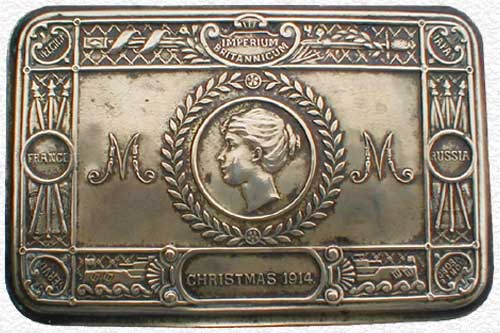
Christmastime is upon us, though we have not had any snow in the last month here in Connecticut and the weather is confusingly blithe. In spite of the friendly temperatures and distinct lack of a need for boots/gloves/hat/scarf at all times, I have begun my Christmas shopping and am doing a bit of holiday crafting each evening. It seems to be time to bring the Yuletide to "Ghosts of 1914," so I thought I would write a bit about the wartime gift meant for everyone in the British Army: The Princess Mary Christmas Gift Box.
The Princess Mary Christmas Gift Box, Village of Kinnethmont, Scotland, website.
James M. Grant's Village of Kinnethmont website has a lovely overview of the Christmas Gift Box's history and contents. According to Grant and other sources, Princess Mary, the daughter of King George V, established a Christmas Gift Fund for soldiers and sailors in November, 1914, to collect contributions towards a present for those on the front. Donations were plentiful, and it was decided that the best present for each soldier or sailor would be a metal box with thoughtful treats and other items. So thoughtful was the gift, in fact, that there was a version for smokers and for non-smokers!

Christmas Box and contents for smokers, © IWM, EPH 1992.

Writing Stationery from a non-smoker's Christmas Box, ©IWM, EPH 2073.
Beyond the differences for smokers and non-smokers, the boxes contained different assortments of items, depending on their recipients. Mr. Dick Elliot, of cigarhistory.info writes about the Gift Box that:
Officers and men on active service afloat or at the front received a box containing a combination of pipe, lighter, 1 oz of tobacco and 20 cigarettes in distinctive yellow monogrammed wrappers. Non-smokers and boys received a sterling silver bullet pencil in a .303 cartridge and a pack of sweets instead. Indian troops often got sweets and spices. Nurses were treated to chocolate. Contrary to opinion, they did not contain cigars. Many of these items were distributed separately from the tins themselves, as once the issue of tobacco and cigarettes was placed in the tin there was little room for much else apart from the greeting card.     
--Dick Elliot, "The Princess Mary Tin"  
In addition to the soldiers and nurses who received the boxes, the families of those who had been killed prior to Christmas, 1914, were also entitled to a tin. Though not every soldier received a box  that year, due to the hazards and complications of delivery during combat, it is a testament to the tins' wide distribution and their sentimental value that the IWM features several (kept by veterans and/or their families and donated to the museum) in their permanent WWI galleries, as I observed when there in June, 2010. The museum's "Women, War, and Society" database also includes many documents relevant to the history of Princess Mary's Fund and the Christmas tins.

The BBC Schools WWI website has an intriguing little interactive feature that includes a Christmas Gift Box among other artifacts that a typical British soldier would have amassed during his service.

Well, we'll close the lid on this little Christmas Box post for now, but we will continue the holiday-themed entries at "Ghosts of 1914." In light of the time of year and perhaps in honor of the ghosts of 1914-1918, I hope that you will consider a holiday contribution of some kind for veterans or soldiers serving today. Until next time, may your days be merry and bright.

© Fiona Robinson