Showing posts with label conscientious objectors. Show all posts

Tuesday, August 28, 2012

A Trek on Dissertation Mountain


"Mt. Fuji in Autumn."Gorota Kawai fl.ca. 1920-30s
O snail
Climb Mount Fuji,
But slowly, slowly!
                                                   --Kobayashi Issa

I am quite busy these days with dissertation writing. The good news is that I have, technically, written all of the chapters. The less than wonderful news is that I have a lot of revisions to finish. And that means that the next several weeks will be spent, in large part, obsessing about Virginia Woolf, Lytton Strachey, Vera Brittain, Siegfried Sassoon, and their literary friends and relations. When I feel overwhelmed at having to climb--or keep climbing--what I call Dissertation Mountain, I just think of myself as Issa's snail, tracing one little silvery dash behind him at a time. Mount Fuji can be climbed, even if slowly. And so can Dissertation Mountain.

Dora Carrington. Lytton Strachey, 1916. ©.NPG 6662

Another thing I do when I feel overwhelmed or disenchanted with this mountain of my making is to watch movies that have to do with my subject(s) or their time period while I work. It helps immensely to have the pleasant, undemanding, company of a familiar film while one types, deletes, has revelations, despairs, and returns to typing once again. One letter, one word on the blank page at a time, a veritable and virtual Mount Fuji slowly covered with the silvery snail tracks of my writing. The most important thing is to keep going!

My film of choice right now is one of my all-time favorites. I've been in love with it since I first saw it over ten years ago, as part of a spectacular Bloomsbury art show at the Yale Center for British Art. I've watched it time and again and even used it in a course I taught at Yale about Bohemians in literature from Shakespeare to Kerouac. It is Carrington. Now, Michael Holroyd's Lytton Strachey and Gretchen Gerzina's Dora Carrington: A Life offer many more details than any film could provide about the lives of the two incredible figures portrayed. However, if you are a Bloomsbury fan, a twentieth-century enthusiast, a (secret) Bohemian, a fashion history person, a literature and/or art scholar, or a period drama film-lover, then do watch this movie. 
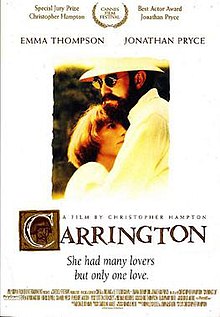
 

Carrington (1995)

I recall being annoyed when my own copy of Holroyd's Strachey arrived a few years ago, with the image of the film's stars as Strachey and Carrington emblazoned on its cover. As a rule, I do not approve of film posters as book covers or endorsements from modern authors on classic texts (among other things). But, much as I might not have liked receiving the Carrington-decorated copy of this beautiful biography, I do love this film. There are many reasons why I enjoy it so much. Sparing myself (and you) from too many of them, it's one of my favorites because it is about real people, an era, and art and writing in which I'm interested and, more broadly, because it's about human relationships that defy standard categories but are defined--wildly and genuinely--by love.

Enough, already. I must pack up this little encampment and seek higher ground on Dissertation Mountain. I hope you enjoy the film, the two biographies, or, if you are a fellow graduate student or writer or anyone with a mountain-like project in front of you, I hope that you can be inspired to keep climbing--but slowly, slowly!

© Fiona Robinson

Tuesday, July 24, 2012

"Link Soup": Exciting Finds

For all of you Sassoon enthusiasts, I just wanted to post a link to an amazing exhibition website. "Dream Voices: Siegfried Sassoon, Memory, and War" was held in 2010 at the Cambridge University Library. Though we've missed the chance to see it in person, there is an excellent web exhibition with many wonderful artifacts from the collection and lots of great information:

"Dream Voices: Sassoon, Memory, and War."
http://www.lib.cam.ac.uk/exhibitions/Sassoon/index.html

If you'd like yet more on Sassoon, a 2004 article from The Telegraph discusses his beloved family home, Weirleigh:
"Haunted By the Memories"
http://www.telegraph.co.uk/property/3334004/Haunted-by-the-memories.html

Finally, I ran across this posting from the Library of the Society of Friends, about the papers of Rachel Wilson, a Quaker woman who served as an ambulance nurse during the First World War:
"Rachel Eveline Wilson Papers"
http://librarysocietyfriendsblog.wordpress.com/2012/05/25/rachel-eveline-wilson-papers-and-our-new-exhibition-an-insight-into-the-life-of-a-world-war-i-friends-ambulance-unit-nurse/

I will continue regular posts of "link soup": tidbits that I find in my excursions on the web while doing research. If you'd like to receive soup in smaller, more "real time"-like servings, then follow "Ghosts of 1914" on Twitter, where I post individual findings quite often.

Till next time,
Fiona

Tuesday, June 26, 2012

Raise the Flag: Semaphore Signaling for War and Peace

Horace Nicholls. Girl Guides Practicing Semaphore Signaling, ca. 1914-18.© IWM, Item Q30965
I ran across this photograph of young women practicing semaphore signaling in a random search of the IWM's collections database. The two Girl Guides (whose scouting organization had been founded in 1910 by Robert Baden-Powell) seem quite serious about their enterprise, and for good reason. 


British semaphore signal flags, undated.  © IWM, Item FLA 849
Semaphore signaling was an important method of communication. A simple way of transmitting information at a distance, it originated in the late eighteenth century and came to have many uses. For instance, railroads were known to use semaphore signaling to control train traffic and ensure safety. The essential component of the system is the use of movable arms (above demonstrated quite literally) to hoist signal flags. According to a 1918 encyclopedia entry on signaling, the British Navy used a system of seven positions. An entire alphabet could be signaled depending on the positioning of the flags. The system is still used today, though much more rarely than it once was.

Semaphore Alphabet, from Capt. E.J. Solano's book, Signalling, 1918.

Women practicing semaphore signaling at a summer camp, Hertsfordshire, 1916.  © IWM, Item Q 108031
Women young and older clearly took an interest in semaphore signaling on the Great War homefront, as the two fascinating photos from the IWM's collection show us. Signaling officers on the battlefields, like the young man who once owned the set of instructional cards below, used semaphore signals to communicate important information during combat.
"Semaphore Signaling in a Week" instructional card set, ca. 1916. © IWM, Item EPH 2507
A British Pathe film from the war era shows multiple women demonstrating semaphore flag signaling at  an unknown location. Such evidence suggests that women's war efforts included the learning of the semaphore system as a way of mobilizing the homefront, of being prepared for emergency communications, should other, more technologically dependent, methods become unavailable.

Fascinatingly, an anti-war symbol that we all recognize is based on semaphore signals. As an informative BBC News article details, the peace sign was developed by Gerald Holtom, a conscientious objector during World War Two. His symbol debuted in the 1950s at a British protest demanding nuclear disarmament. The semaphore signals for "N" and "D," when combined, create the iconic image:

"Decoding the Logo," BBC News Magazine.
The artifacts we have here show us that semaphore signals were an essential part of information transmission on the battlefield and a part of women's homefront service during the Great War. The semaphore system, with its instructional silhouetted figures gripping flags or photographs of eager young people practicing with arms held aloft, is one example of  communication, already heavily electronically mediated by the time of the war, remaining human--conveying important military messages, homefront anxieties, and, eventually, hopes for a more peaceful world.

© Fiona Robinson