Showing posts with label strachey. Show all posts

Tuesday, August 28, 2012

A Trek on Dissertation Mountain


"Mt. Fuji in Autumn."Gorota Kawai fl.ca. 1920-30s
O snail
Climb Mount Fuji,
But slowly, slowly!
                                                   --Kobayashi Issa

I am quite busy these days with dissertation writing. The good news is that I have, technically, written all of the chapters. The less than wonderful news is that I have a lot of revisions to finish. And that means that the next several weeks will be spent, in large part, obsessing about Virginia Woolf, Lytton Strachey, Vera Brittain, Siegfried Sassoon, and their literary friends and relations. When I feel overwhelmed at having to climb--or keep climbing--what I call Dissertation Mountain, I just think of myself as Issa's snail, tracing one little silvery dash behind him at a time. Mount Fuji can be climbed, even if slowly. And so can Dissertation Mountain.

Dora Carrington. Lytton Strachey, 1916. ©.NPG 6662

Another thing I do when I feel overwhelmed or disenchanted with this mountain of my making is to watch movies that have to do with my subject(s) or their time period while I work. It helps immensely to have the pleasant, undemanding, company of a familiar film while one types, deletes, has revelations, despairs, and returns to typing once again. One letter, one word on the blank page at a time, a veritable and virtual Mount Fuji slowly covered with the silvery snail tracks of my writing. The most important thing is to keep going!

My film of choice right now is one of my all-time favorites. I've been in love with it since I first saw it over ten years ago, as part of a spectacular Bloomsbury art show at the Yale Center for British Art. I've watched it time and again and even used it in a course I taught at Yale about Bohemians in literature from Shakespeare to Kerouac. It is Carrington. Now, Michael Holroyd's Lytton Strachey and Gretchen Gerzina's Dora Carrington: A Life offer many more details than any film could provide about the lives of the two incredible figures portrayed. However, if you are a Bloomsbury fan, a twentieth-century enthusiast, a (secret) Bohemian, a fashion history person, a literature and/or art scholar, or a period drama film-lover, then do watch this movie. 
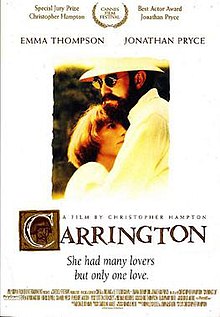
 

Carrington (1995)

I recall being annoyed when my own copy of Holroyd's Strachey arrived a few years ago, with the image of the film's stars as Strachey and Carrington emblazoned on its cover. As a rule, I do not approve of film posters as book covers or endorsements from modern authors on classic texts (among other things). But, much as I might not have liked receiving the Carrington-decorated copy of this beautiful biography, I do love this film. There are many reasons why I enjoy it so much. Sparing myself (and you) from too many of them, it's one of my favorites because it is about real people, an era, and art and writing in which I'm interested and, more broadly, because it's about human relationships that defy standard categories but are defined--wildly and genuinely--by love.

Enough, already. I must pack up this little encampment and seek higher ground on Dissertation Mountain. I hope you enjoy the film, the two biographies, or, if you are a fellow graduate student or writer or anyone with a mountain-like project in front of you, I hope that you can be inspired to keep climbing--but slowly, slowly!

© Fiona Robinson

Friday, January 6, 2012

WWI Bookshelf: Eminent Victorians

Happy New Year to my readers! I wish you all the best in 2012. The turn of the new year is a time when the present breaks away, actually and symbolically, from the past. It is a time when our thoughts often turn to what is next and to what we will do to make the future different from what has come before. As I reflected on where to go next here at "Ghosts of 1914," I thought I would mention a text that has a lot to do with the boundaries between past, present, and future: Lytton Strachey's Eminent Victorians, published in 1918.
One of my favorite paintings in the whole world:
Dora Carrington. Lytton Strachey, 1916. National Portrait Gallery, London, Item NPG 6662
Though this quartet of biographical portraits concerns celebrated figures from the Victorian era, it speaks volumes about the distance that some modern Britons wanted to put between themselves and that storied recent period in England. For Strachey, a Bloomsbury Group pacifist and conscientious objector who wrote the four biographies over the war years, Eminent Victorians was a way of taking a stand against the past's power to define the present and future. We might consider Strachey's position on the war to be one of unwillingness to believe that the sacrifice of individual lives was a fitting price  to pay for the upholding of a propagandistically rendered British identity built on dusty Victorian ideals.
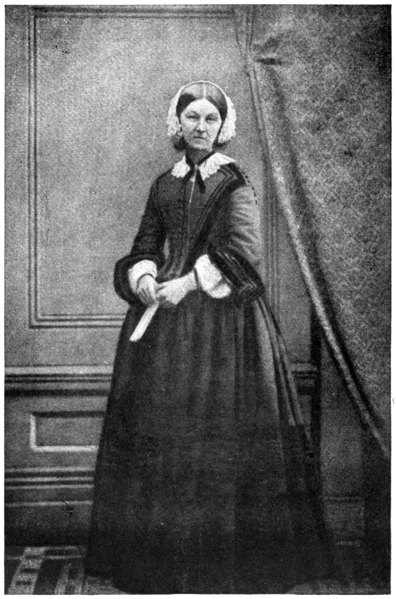
Florence Nightingale, ca 1858. Portrait used in Eminent Victorians, 1918.
Strachey sought to change the way we regard illustrious people of the past. Rather than granting them some kind of exalted, almost superhuman status, Strachey wanted us to consider the residents of history as people, just like ourselves. Strachey's portraits, which are meticulously detailed, fussy, unsparing, and often hilarious, don't allow his readers to envision his subjects--General Gordon, Cardinal Manning, Florence Nightingale, and Thomas Arnold--as heroes or immortals. Rather, they insist on the flawed but ultimately more accessible, realistically-proportioned, humanity of these four people. 

Among his other writings, Strachey would go on to pen a sensational biography of Queen Victoria, which was published in 1921. About his skillful and realistic representation of the monarch, Strachey's friend Virginia Woolf wrote that, "in time to come [his] Queen Victoria will be Queen Victoria," (Woolf, "The Art of Biography").
W. & D. Downey. Queen Victoria, 1897. National Portrait Gallery, London, Item NPG x12984
Using writing as a tool for pacifism was a remarkable project, and Strachey's efforts to bring down the idols of the recent past so that modern Britons could be free of their firm hold on national and cultural identity are an essential aspect of Great War era British literature. For Strachey, there was hope that writing lives was a way of saving lives.

© Fiona Robinson