Showing posts with label art. Show all posts

Thursday, November 29, 2012

Remember November: Sweetheart Brooches

Hello Dear Readers,

A simple post today about a particular kind of Great War artifact: the sweetheart brooch.
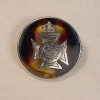
Above is a lovely example of a sweetheart brooch, a commonly exchanged jewelry item during both twentieth century world wars. The brooch tradition, some say, began with the Boer War, though soldiers and loved ones have exchanged various small tokens of remembrance for ages. There are, furthermore, non-military sweetheart brooches, which were popular especially in the Victorian era.

Sweetheart brooches are one aspect of the amazing array of insignia that civilians donned during the Great War. For example, I wrote some time ago about my own Needlework Guild Badge, a small symbolic brooch for textile volunteers. As wartime tokens of remembrance, sweetheart brooches symbolized relationships, pride, and served as a visual symbol of the constant stream of thoughts flowing between service-people and civilians. The below photograph, from the wonderful British Army Children's Archive, shows a mother and her baby. The woman, whose tightly clenched right fist (resting on her knee) and somewhat weary look seem to evidence fatigue, grief, and determination, wears a sweetheart brooch at the top center of her blouse. 
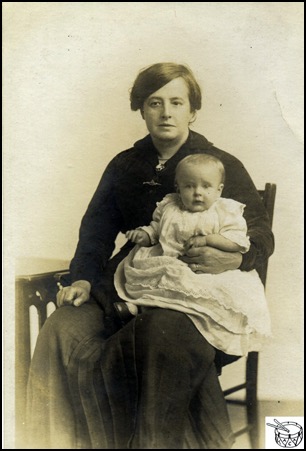
WWI mother and child, with mother wearing a sweetheart brooch. © TACA
A brooch wearer like the woman above reminded others who saw her of an important relationship, though her partner or relative was absent. I like to think, furthermore, that seeing the brooch on one's own clothing in the mirror or touching it, whether with an unintentional graze of the hand or purposeful contact, was part of a sweetheart brooch's emotional "technology." Many kinds of jewelry offer such transmissions of feeling or thought, whether helping to recall memories or gather, momentarily (as when we slide a locket along a necklace or caress a wedding ring), an expansive set of emotions. Are such gestures truly absent-minded? I don't think they can be entirely...

Sweetheart brooches came in many forms, often symbolizing a soldier's regiment and marrying romantic and military imagery. The Empire to Commonwealth Project's website has the widest collection of sweetheart brooch images I could find. From around the web, here are a few other examples:

WWI-era Royal Navy Sweetheart Brooch with mother-of-pearl backing. © Field Service Antique Arms and Militaria.

Silver sweetheart brooch of the Liverpool Pals, n.d. © IWM, Item INS 6139.

I hope you've enjoyed this little excursion through one of my own favorite aspects of WWI material history. This post concludes November's month of remembrance-themed writings. Next month I'll be looking at holidays and festivities on the front and at home. Thanks for reading and stay tuned!


© Fiona Robinson

Friday, November 16, 2012

The Cenotaph Unveiled

On November 11, 1920, the Whitehall Cenotaph war monument was unveiled in London. The memorial, by definition an empty tomb, honored the staggering numbers of British war dead, nearly all of whom were buried abroad. Crowds gathered to see Edwin Luytens's impressive structure as part of the day's solemn events. As I have written earlier, attendees would later proceed to Westminster Abbey for the Unknown Warrior's funeral service. 
Horace Nicholls. The Cenotaph about to be unveiled, 11 Nov. 1920. © IWM, Item Q 31489. 
There are many excellent resources on the history of the Whitehall Cenotaph. Rather than retreading familiar ground, I thought I'd share a few artifacts and facts with you today. First of all, I found the following amazing newsreel about the Armistice Day 1920 ceremonies. There is footage of the Unknown Soldier's return to London as well as of King George V unveiling the Cenotaph (at 5:18):


And here is Edwin Luyten's model of the Cenotaph as envisioned after he was commissioned in June 1919 to commemorate the signing of the Peace Treaty with Germany:

Edwin Luytens. Model for Whitehall Cenotaph, 1919.  © IWM, Item ART 4207.
As the IWM's detailed description for the model states, Luyten's commission to honor the Peace Treaty evolved into the Cenotaph's spartan form over the course of discussions with David Lloyd George and other government officials. Lloyd George had asked Luytens to construct a ceremonial catafalque; Luytens modified this plan to create a cenotaph instead.

Before the official unveiling in 1920, a temporary monument, designed by Luytens and constructed of wood and plaster, had stood in its place. Below is a photo of the top of the original Cenotaph. Sadly, as historian Gaynor Kavanaugh writes, the original structure, which was held in the Imperial War Museum's collections from the 1920s, was destroyed by a bomb during World War Two.

Horace Nicholls. The top of the original Cenotaph, on display at the Crystal Palace, 1920-24. © IWM, Item Q 31521.

The Whitehall Cenotaph continues to be one of London's most recognized monuments and a focal point of commemorative services each year. It was also, for a time, as I have written, a focal point for Spiritualists' haunting photography and claims about the return of the ghostly war dead.

When I visited London a couple of years ago, I remember seeing faded poppy wreaths and decorations laid at the foot of this striking and somewhat eerie structure. Many cities across the world have constructed their own cenotaphs to honor the dead of various wars. You can often find such memorials on town greens or at street crossings in communities large and small. 
Horace Nicholls. Whitehall Cenotaph, 11 November 1920. © IWM, Item Q 31497.
For more on the Whitehall Cenotaph, consult the IWM's incredibly vast resources on the monument and its history. See also Neil Hanson's book, Unknown Soldiers and Allyson Booth's wonderful critical work, Postcard from the Trenches. BBC News has a video history of the Cenotaph. See also Derek Boorman's book, At the Going Down of the Sun.

© Fiona Robinson

Tuesday, August 28, 2012

A Trek on Dissertation Mountain


"Mt. Fuji in Autumn."Gorota Kawai fl.ca. 1920-30s
O snail
Climb Mount Fuji,
But slowly, slowly!
                                                   --Kobayashi Issa

I am quite busy these days with dissertation writing. The good news is that I have, technically, written all of the chapters. The less than wonderful news is that I have a lot of revisions to finish. And that means that the next several weeks will be spent, in large part, obsessing about Virginia Woolf, Lytton Strachey, Vera Brittain, Siegfried Sassoon, and their literary friends and relations. When I feel overwhelmed at having to climb--or keep climbing--what I call Dissertation Mountain, I just think of myself as Issa's snail, tracing one little silvery dash behind him at a time. Mount Fuji can be climbed, even if slowly. And so can Dissertation Mountain.

Dora Carrington. Lytton Strachey, 1916. ©.NPG 6662

Another thing I do when I feel overwhelmed or disenchanted with this mountain of my making is to watch movies that have to do with my subject(s) or their time period while I work. It helps immensely to have the pleasant, undemanding, company of a familiar film while one types, deletes, has revelations, despairs, and returns to typing once again. One letter, one word on the blank page at a time, a veritable and virtual Mount Fuji slowly covered with the silvery snail tracks of my writing. The most important thing is to keep going!

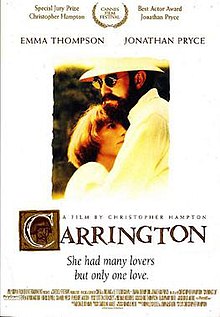
My film of choice right now is one of my all-time favorites. I've been in love with it since I first saw it over ten years ago, as part of a spectacular Bloomsbury art show at the Yale Center for British Art. I've watched it time and again and even used it in a course I taught at Yale about Bohemians in literature from Shakespeare to Kerouac. It is Carrington. Now, Michael Holroyd's Lytton Strachey and Gretchen Gerzina's Dora Carrington: A Life offer many more details than any film could provide about the lives of the two incredible figures portrayed. However, if you are a Bloomsbury fan, a twentieth-century enthusiast, a (secret) Bohemian, a fashion history person, a literature and/or art scholar, or a period drama film-lover, then do watch this movie. 
 

Carrington (1995)

I recall being annoyed when my own copy of Holroyd's Strachey arrived a few years ago, with the image of the film's stars as Strachey and Carrington emblazoned on its cover. As a rule, I do not approve of film posters as book covers or endorsements from modern authors on classic texts (among other things). But, much as I might not have liked receiving the Carrington-decorated copy of this beautiful biography, I do love this film. There are many reasons why I enjoy it so much. Sparing myself (and you) from too many of them, it's one of my favorites because it is about real people, an era, and art and writing in which I'm interested and, more broadly, because it's about human relationships that defy standard categories but are defined--wildly and genuinely--by love.

Enough, already. I must pack up this little encampment and seek higher ground on Dissertation Mountain. I hope you enjoy the film, the two biographies, or, if you are a fellow graduate student or writer or anyone with a mountain-like project in front of you, I hope that you can be inspired to keep climbing--but slowly, slowly!

© Fiona Robinson

Tuesday, July 24, 2012

"Link Soup": Exciting Finds

For all of you Sassoon enthusiasts, I just wanted to post a link to an amazing exhibition website. "Dream Voices: Siegfried Sassoon, Memory, and War" was held in 2010 at the Cambridge University Library. Though we've missed the chance to see it in person, there is an excellent web exhibition with many wonderful artifacts from the collection and lots of great information:

"Dream Voices: Sassoon, Memory, and War."
http://www.lib.cam.ac.uk/exhibitions/Sassoon/index.html

If you'd like yet more on Sassoon, a 2004 article from The Telegraph discusses his beloved family home, Weirleigh:
"Haunted By the Memories"
http://www.telegraph.co.uk/property/3334004/Haunted-by-the-memories.html

Finally, I ran across this posting from the Library of the Society of Friends, about the papers of Rachel Wilson, a Quaker woman who served as an ambulance nurse during the First World War:
"Rachel Eveline Wilson Papers"
http://librarysocietyfriendsblog.wordpress.com/2012/05/25/rachel-eveline-wilson-papers-and-our-new-exhibition-an-insight-into-the-life-of-a-world-war-i-friends-ambulance-unit-nurse/

I will continue regular posts of "link soup": tidbits that I find in my excursions on the web while doing research. If you'd like to receive soup in smaller, more "real time"-like servings, then follow "Ghosts of 1914" on Twitter, where I post individual findings quite often.

Till next time,
Fiona