Showing posts with label poets and poetry. Show all posts

Tuesday, July 29, 2014

And so it began to begin...

As one who hangs down-bending from the side
Of a slow-moving boat, upon the breast
Of a still water, solacing himself
With such discoveries as his eye can make
Beneath him in the bottom of the deep,
Sees many beauteous sights--weeds, fishes, flowers,
Grots, pebbles, roots of trees, and fancies more,
Yet often is perplexed, and cannot part
The shadow from the substance, rocks and sky,
Mountains and clouds, reflected in the depth
Of the clear flood, from things which there abide
In their true dwelling; now is crossed by gleam
Of his own image, by a sunbeam now,
And wavering motions sent he knows not whence,
Impediments that make his task more sweet;
Such pleasant office have we long pursued
Incumbent o'er the surface of past time
With like success, nor often have appeared
Shapes fairer or less doubtfully discerned
Than these to which the Tale, indulgent Friend!
Would now direct thy notice.

 --William Wordsworth, The Prelude, Book 4, ll. 256-76
                  

Hello Readers,
It's somewhat strange, waiting with bated breath for the steady gears of history to make their circuit towards the date when we can look back exactly one hundred years to the start of the Great War. It's as though we anticipate some kind of perspicuity that, like gazing down into a glass-clear lake, is only possible when the present aligns with the past just so. Like Wordsworth's boy looking down into the "still water" and confused by the reflections therein of sky and earth and of "his own image", though, perhaps we may find (and perhaps we already know) that shadow and substance cannot be so easily separated. Though the great span of time that a centennial marks might suggest a certain poignant stillness, calming the past into clarity and granting us objective distance, our own image may surprise us in those depths. What might we learn about ourselves and our world by looking  for and listening to those ghosts of 1914? As we have for some time now on this blog, we shall continue ask to this very question. We will continue to chase shadow and substance in the (deceptively) glassy deep of hundred-year-old history.

As we near and enter the official centenary, it is my aim to direct the blog towards following events of the war's unfolding over the years 1914-1918. 

To that end, I present a small collection of articles about the events of exactly one hundred years ago, when Austria-Hungary declared war on Serbia:


And a last-but-not-least suggestion: hstry.org's fascinating "Back to the Mud" blog series on one man's adventure through family WWI history.


Till next time,
Fiona


© Fiona Robinson

Monday, October 29, 2012

War Poems for Halloween


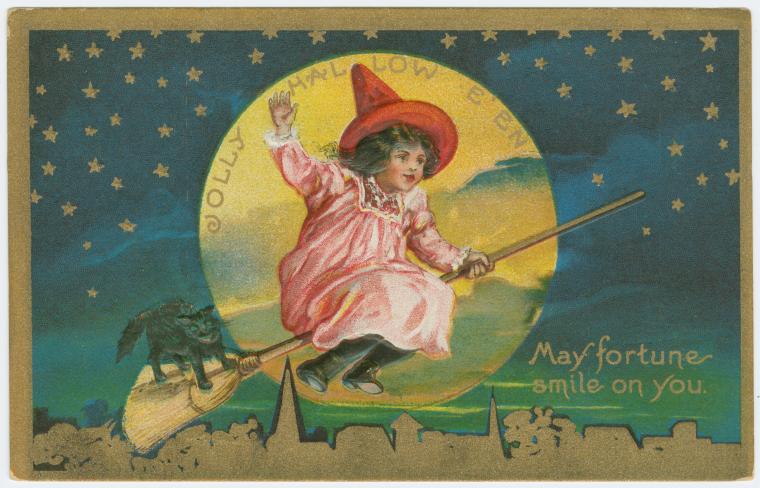
"A Jolly Hallow-e'en" Vintage Postcard, ca. 1910. © NY Public Library Picture Collection.
A fascinating find for Halloween week:

Winifred M. Letts's Hallow-e'en and Poems of the War is widely available online for those of you would like to delve a bit into Halloween and Great War history.

Letts, born in 1882, was of English and Irish heritage. She was also a versatile writer, penning novels, poems, plays, and children's fiction over her career.

The Halloween-themed poems in Letts's collection are touching, rather tragic, musings. They offer an older-world vision of Halloween as a holiday when the spirits of the dead might return to familiar places and people. "Hallow-e'en 1915," for example, is an emotional appeal to the war dead, hoping that they will be drawn by the welcoming lights of home. Hearth fires, stars, lanterns, and lamps are all described as beacons for the "well-beloved dead."

O men of the manor and moated hall and farm
Come back to-night; treading softly over the grass;
The dew of the autumn dusk will not betray where you pass;
The watchful dog may stir in his sleep but he'll raise no hoarse alarm.
--Winifred M. Letts, "Hallow-e'en 1915," (5-8)
Other pieces of note in this great collection are "The Deserter," a well-known piece that considers the plight of those too fearful to fight, and "A Sister in a Military Hospital," about nurses much like those whose uniforms might inspire a costume or two, as I have written previously.

Letts's book connects Halloween to the First World War in an unexpected way, offering a different perspective on the holiday than the one we might know today. In her poems, mingling with ghosts on "Hallow-e'en" is a longed-for reunion rather than a spooky thrill. Most importantly, however, Halloween is for Letts, as it remains today, a time of possibilities, a brief night when real and unreal can come together and a slightly different, more magical, world appears.

© Fiona Robinson

Tuesday, July 24, 2012

"Link Soup": Exciting Finds

For all of you Sassoon enthusiasts, I just wanted to post a link to an amazing exhibition website. "Dream Voices: Siegfried Sassoon, Memory, and War" was held in 2010 at the Cambridge University Library. Though we've missed the chance to see it in person, there is an excellent web exhibition with many wonderful artifacts from the collection and lots of great information:

"Dream Voices: Sassoon, Memory, and War."
http://www.lib.cam.ac.uk/exhibitions/Sassoon/index.html

If you'd like yet more on Sassoon, a 2004 article from The Telegraph discusses his beloved family home, Weirleigh:
"Haunted By the Memories"
http://www.telegraph.co.uk/property/3334004/Haunted-by-the-memories.html

Finally, I ran across this posting from the Library of the Society of Friends, about the papers of Rachel Wilson, a Quaker woman who served as an ambulance nurse during the First World War:
"Rachel Eveline Wilson Papers"
http://librarysocietyfriendsblog.wordpress.com/2012/05/25/rachel-eveline-wilson-papers-and-our-new-exhibition-an-insight-into-the-life-of-a-world-war-i-friends-ambulance-unit-nurse/

I will continue regular posts of "link soup": tidbits that I find in my excursions on the web while doing research. If you'd like to receive soup in smaller, more "real time"-like servings, then follow "Ghosts of 1914" on Twitter, where I post individual findings quite often.

Till next time,
Fiona