Monday, February 27, 2012

Every Fit Woman

Unknown Artist, "Every Fit Woman Can Release a Fit Man," ca. 1917-18. © IWM (Art.IWM PST 4881)
It's always so great to find an archival item just brimful of energy. This poster jumped out at me for exactly that reason amid a more general search of the Imperial War Museum's great Collections Database. The image features a bright and confident young woman waving to the (presumably) female viewer, as if to summon her over to the ranks of the many happy and hearty looking ladies assembled behind her. The billowing British flag adds to a feeling of motion and dynamism here. The uniformed bodies that touch one another to form a more unified mass of Women's Army Auxiliary Corps members convey integrity and solidified strength. With such a cheerful and compelling figure to welcome us, how could we resist the call to "release a fit man" for service? 

For readers inspired by the above image, the IWM's "Women's War Work During the First World War" site is an excellent resource. It's full of information and artifacts illustrating many aspects of women's experience and service.

© Fiona Robinson

Tuesday, February 14, 2012

Love, War, and Chocolate

Happy Valentine's Day to my readers! In honor of the day, I wanted to put together a post about the history of chocolate in the Great War. Information on the kinds of chocolate distributed to soldiers in the British Army is not as easy to come by as I assumed, so this will be a work in progress. For now, though, I can offer this image from the Suburban Birmingham Project, a history website featuring various artifacts relevant to Birmingham, England's past. In it, female employees of Cadbury's Chocolate pack boxes with chocolate and books for soldiers.

 Cadbury employees assembling packages for soldiers, ca. 1915-18.
 As Suburban Birmingham's information about this image states,
"As soon as war broke out and troops were deployed overseas, Cadbury Bros began producing ‘chocolate for the troops’. These gifts continued to be distributed throughout the duration of the war and in total 20,000 parcels were sent out to troops on the front, as well as to those who were wounded and recovering at home or in hospital."
Even before the Great War, chocolate was often sent to soldiers. Like the Princess Mary Gift Box distributed at Christmas, 1914, the Boer War's Queen Victoria Chocolate Tin contained a gift of chocolate for British troops engaged in South Africa in 1899-1900. The Canadian Anglo-Boer War Museum's website has some interesting details and images related to this earlier instance of chocolate's role in wartime. The BBC's "History of the World" web resource features a nice image of the tin:

Queen Victoria Chocolate Tin, ca. 1899-1900. BBC

Chocolate was seen as a valuable gift to soldiers for many reasons. Though we bemoan this reality today, the confection supplies a boost of sugar and calories, which could help revive a hungry or fatigued soldier. It is also a source of comfort and/or pleasure, a small pick-me-up for a hospital patient, for instance. 

After the war, Cadbury's purchased what was probably its greatest competitor in the commercial chocolate "wars," Fry's Cocoa. Both companies had been started by prominent Quaker families of Northern England. Slightly older than Cadbury's, having been founded in the eighteenth century, J.S. Fry and Sons, Ltd. was based in Bristol, England. In 1919, the two cocoa titans merged together as the British Chocolate and Cocoa Company.

Another interesting aspect of Cadbury's history is the model village of Bournville, built in Birmingham during the late Victorian period by George and Richard Cadbury. Ground-breaking for its time, the village was intended to support a wholesome lifestyle for factory workers. It included housing, schools, museums, churches, and sporting arenas, offering access to safe and healthful conditions and activities for those who worked in the Cadbury factories. The bulk of construction was completed by the time of the Great War, although the village continued to expand into the twentieth century.

Well, it is time to sign off for the moment. Do enjoy some chocolate or cocoa in honor of the holiday or simply in honor of the history of this confection and its importance to the Ghosts of 1914.

© Fiona Robinson

Tuesday, February 7, 2012

The Last Ghost of 1914

A brief post today to remember Florence Green, the last surviving veteran of the Great War. She passed away a few days ago in Norfolk, England, at the age of 110. Mrs. Green joined the then-newly founded Women's Royal Air Force (WRAF) during the last months of the war, in autumn of 1918. As a war worker, she served meals to officers at the RAF Marham base and at Narborough airfield. The BBC has a video of Mrs. Green talking about her experiences, along with further details about her life.

Photo of Florence Green with her WRAF service corps at Narborough airfield, 1918.
With Green now gone, along with Claude Choules (the last male British veteran), Harry Patch, and Frank Buckles (the last American veteran), who also made up the small company of longest-lived veterans, we have entered a new era. The experience of the Great War is no longer among the living but now lives in memory. It is a momentous thing for a war to pass fully from recall to record. It is important, in the face of such an inevitability, to preserve the human hold on history and to maintain our perspective on the events of the Great War such that we understand (or try to understand) what it meant to live through it--so that the nature and costs of such a conflict remain human-scaled, even at a vantage point of a hundred years away. I feel that it is only with such a perspective that the history of war can point to peace.

In the spirit of maintaining a human hold on history, I urge you to seek out the recollections of family and friends. NPR's StoryCorps project offers an inspirationally wide array of recorded personal stories, some of which are about combat experience. Ask an elder in your community to tell you about his or her memories. Take notes and ask questions. Bring a tape recorder. I guarantee you a fascinating chat, whether you talk of war and peace or cabbages and kings.

© Fiona Robinson

Friday, February 3, 2012

My Telephonic Valentine

"Hello! My Dearie" Valentine, British Postal Museum & Archive.
Hello, my dear readers. I feel like I'm writing here after too long an absence, reaching out across the chasm that a dissertation and related duties sometimes create between oneself and one's more personal projects. This entry is a way of bridging that gap, of reconnecting to you and to the "Ghosts of 1914." In honor of such technological reconnection and in honor of the upcoming yearly feting of love in all its forms, I offer you the above Valentine. What a wonderful image we have here, from the collections of the British Postal Museum and Archive, which happens to have a great online exhibition about the Great War's impact on the Postal Service. The couple represented in the Valentine are separated by a rather pleasant looking body of water, which we can assume is the English Channel between Britain and France. The sun glints peacefully under the (absolutely delightful) "Hello" spelled by the telephone wire that connects the soldier and his lovely lady. More than just wide blue waves sets the man apart from his mate, however, with his spartan wooden table, uniform, and situation in a bunker contrasting sharply with the woman's diaphanous white gown and dainty heels, her strand of pearls and blue sash, and the comfortable domestic setting in which she sits. Front and home are signified in all of these ways--war and peace as well, we might imagine. There is even an interesting fantasy of complete focus--we don't see the war "behind" or "around" the soldier, nor do we see any of the signifiers of responsibility, anxiety, or distraction in the woman's realm. The telephone somehow serves to isolate the two lovers, bringing them close and dulling the sights and sounds that would remind them of their distance. He leans his ear against the telephone receiver, eyes fixed on some vision beyond his situation--presumably picturing what we see on the right side of the postcard: the woman with her ear pressed equally attentively to the receiver as she speaks into the mouthpiece, her whole posture and expression signifying that she is fully dedicated to this communication.

The verse that appears here is somewhat poignant, suggesting the anxious choppiness of an early twentieth century telephone call, with a pleading and emotional message broken into somewhat fitful phrases, all of which  are initiated and completed within an incredibly short span of time. There seems to be no time or words to spare, whether because of the vicissitudes of combat or of the telephone. It must have been quite strange to connect in this way during the Great War and hear the voice of a soldier or a loved one at home come crackling over the wire. No doubt this was a rare privilege for those on either side of the conversation. Here, though, whatever its oddities, the telephone line is imagined as a sort of lifeline, channeling emotion across a great divide and transmitting much more than sound or information. Words, feeling, and modern technology combine in a very touching and fascinating soldier's Valentine here. Until next time, when we (at the very wise suggestion of my mother) again mark the upcoming holiday with a look at the history of chocolate in the war, we'll hang up for now and leave these two ghosts of 1914 to their telephonic love-talk.

© Fiona Robinson

Sunday, January 22, 2012

What to Wear to War III: Timepieces for the Trenches

"H. Samuel's War Watches." © IWM, (Art.IWM PST 13687)
As an avid wristwatch collector, I keep an eye on early timepieces that go up for sale here and there on the web and in shops that I visit. I don't have any particularly valuable items myself, but I enjoy looking at (though not being responsible for the upkeep of) vintage watches from the early decades of the twentieth century.

For our ghosts of 1914, wristwatches were important devices. Most people were still making the transition from pocket watches to the newer style worn on the wrist as the 1910s dawned. The below image, from David Boettcher's vintage watch strap website (which contains lots of excellently presented information about the history of military watches), shows one way to transition a pocket watch, worn on a chain at the waist, for wear at the wrist.

A case for converting a pocket watch for wear on the wrist, ca. 1900. ©David Boettcher's vintagewatchstraps.com
A soldier had a particular need for an easily accessible and sturdy timepiece. As the "H. Samuel's" poster from the Imperial War Museum's collections reveals, there were even watches with "luminous dials," so that the time could be told in the dead of night or amid clouds of smoke or dust. Somewhat distressingly, these radiant dials were, quite often, rather literally radiant--painted with radium, an early luminous material for watch faces.

"Telephone Dial" Trench Watch, 1916. antiquewatchcouk.com
In addition to such features as the glow-in-the-dark dials, trench watches sometimes had thick leather bands that wrapped, like a cuff, around the wrist. They also sometimes came with protective metal fixtures, in the shape of a grille, flip-top, or the anachronistically named "telephone dial" style plate, to save the glass watch face from being shattered.

Having access to the time was essential for planned maneuvers and other military operations. Our old friend, war cinematographer Geoffrey Malins, noted in his memoirs the hectic, almost-sickening, sense of anticipation that built as time ticked down to the planned commencement of the Battle of the Somme on 1 July, 1916.
1917 British Military Wristwatch. ©David Boettcher's vintagewatchstraps.com
I'd like to think that having a wristwatch conveyed some sort of sense of normalcy for those on the front, giving them an indication that time was passing and that each minute would bring them nearer to the end of the war and to the moment that they would be reunited with their loved ones at home.  A better, more peaceful, future was only a matter of so many spins round the numbered dial. It might have been just as difficult, however, to watch the hours ticking by on one's wrist, not sure what the coming moments would bring. Great War wristwatches are certainly a fascinating topic, and we will return to this theme another time at "Ghosts of 1914."

© Fiona Robinson

Sunday, January 15, 2012

Rebuilding the Soldier's Body: Plastic Surgery and Prosthetics in WWI

A soldier with a disfiguring injury receives a mask. Anna Coleman Ladd Papers, 1881-1950. Archives of American Art, Smithsonian Institution.
Amid the "dissertissitudes" of life lately (such as working diligently to revise or, to be more accurate, essentially rewrite a dissertation chapter), I have run across a snippet of research that I thought was good for sharing on "Ghosts of 1914." It is on the very fascinating history of plastic surgery and facial prostheses in the aftermath of WWI.

A sculptor or artist at work on a mask. Anna Coleman Ladd Papers, 1881-1950. Archives of American Art, Smithsonian Institution.
Soldiers who were lucky enough to survive the modern killing machines of the Great War were, quite often, injured and/or maimed in significant ways. One of the most devastating sorts of injuries for a veteran was facial disfigurement, something that could significantly challenge his chances at reintegrating into civilian life, whether at home or within his community.

The field of plastic surgery, about which we remain fascinated even as its procedures become increasingly normalized in our culture (for instance, on the big or small screen, it seems near-impossible to find a female--or even, sometimes, a male--forehead not strangely immobilized or eyebrows not fiercely stretched, lips not comically blocky and protruding, etc., etc., etc.), already existed by the time of the Great War. However, the particularly destructive technologies of the war forced the medical field to adapt in major ways to a new set of demands on their aesthetic and surgical abilities, as Smithsonian Magazine's Caroline Alexander writes in a brilliant 2007 article. Where surgery could not fully rebuild a badly-affected face, artists were employed in crafting ingenious prosthetics that could be worn over the damaged feature so as to give the soldier an approximation of his pre-war appearance. In film footage of American artist Anna Coleman Ladd at work from the Smithsonian Magazine website, it looks like plaster casts (like life-masks) of the faces of the injured are used in the process of making a facial prosthesis.  At one moment, we see a soldier demonstrating just such a "mask," worn over his jaw and chin. Another is fitted with a mask that covers part of the upper portion of his face.

Repairing or restoring a soldier's face was not about frivolous vanity or a quest for some sort of ideal beauty. Instead, it had everything to do with restoring a soldier's place on the homefront--with repairing or at least helping to support the bridge between the worlds of combat and civilian life.

© Fiona Robinson
---

Sources and Further Reading:

Friday, January 6, 2012

WWI Bookshelf: Eminent Victorians

Happy New Year to my readers! I wish you all the best in 2012. The turn of the new year is a time when the present breaks away, actually and symbolically, from the past. It is a time when our thoughts often turn to what is next and to what we will do to make the future different from what has come before. As I reflected on where to go next here at "Ghosts of 1914," I thought I would mention a text that has a lot to do with the boundaries between past, present, and future: Lytton Strachey's Eminent Victorians, published in 1918.
One of my favorite paintings in the whole world:
Dora Carrington. Lytton Strachey, 1916. National Portrait Gallery, London, Item NPG 6662
Though this quartet of biographical portraits concerns celebrated figures from the Victorian era, it speaks volumes about the distance that some modern Britons wanted to put between themselves and that storied recent period in England. For Strachey, a Bloomsbury Group pacifist and conscientious objector who wrote the four biographies over the war years, Eminent Victorians was a way of taking a stand against the past's power to define the present and future. We might consider Strachey's position on the war to be one of unwillingness to believe that the sacrifice of individual lives was a fitting price  to pay for the upholding of a propagandistically rendered British identity built on dusty Victorian ideals.
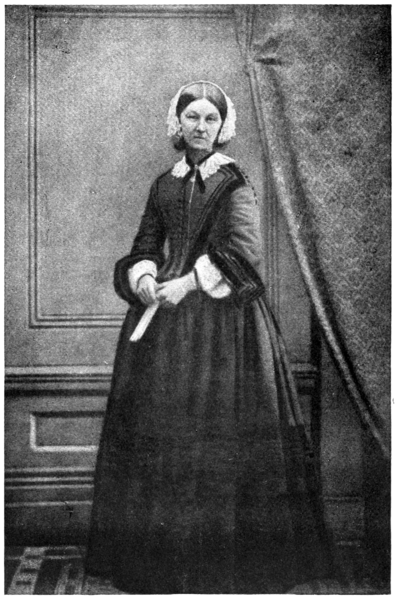
Florence Nightingale, ca 1858. Portrait used in Eminent Victorians, 1918.
Strachey sought to change the way we regard illustrious people of the past. Rather than granting them some kind of exalted, almost superhuman status, Strachey wanted us to consider the residents of history as people, just like ourselves. Strachey's portraits, which are meticulously detailed, fussy, unsparing, and often hilarious, don't allow his readers to envision his subjects--General Gordon, Cardinal Manning, Florence Nightingale, and Thomas Arnold--as heroes or immortals. Rather, they insist on the flawed but ultimately more accessible, realistically-proportioned, humanity of these four people. 

Among his other writings, Strachey would go on to pen a sensational biography of Queen Victoria, which was published in 1921. About his skillful and realistic representation of the monarch, Strachey's friend Virginia Woolf wrote that, "in time to come [his] Queen Victoria will be Queen Victoria," (Woolf, "The Art of Biography").
W. & D. Downey. Queen Victoria, 1897. National Portrait Gallery, London, Item NPG x12984
Using writing as a tool for pacifism was a remarkable project, and Strachey's efforts to bring down the idols of the recent past so that modern Britons could be free of their firm hold on national and cultural identity are an essential aspect of Great War era British literature. For Strachey, there was hope that writing lives was a way of saving lives.

© Fiona Robinson