Tuesday, July 24, 2012

The Theatre of War

"The Child He Will Never See/Great Stage Ball" Poster, 1916. © IWM, Item Art.IWM PST 10819
A quick post today as I pause during a busy phase of dissertation writing. I found this interesting poster in the IWM's Collections Database because I am thinking about pageants and/or theatrical productions during the war. In particular, I'm looking for information about productions of Gilbert and Sullivan (one of my favorite composing/writing/comedic duos) that took place either on the homefront or perhaps for (or performed by) troops on the front. Soldiers and even prisoners of war were known to stage theatrical events as morale-boosters. Just a basic search shows that the theatre was deeply important to wartime culture. The below poster, for instance, emphasizes the importance of the theatre's cheering effect:

"Smiles That Do Good," Poster, 1917. © IWM (Art.IWM PST 13713)
Air Raid Damage to the Little Theatre, London, 1917. © IWM (HO 67)
Civilians on the homefront became anxious because of German air-raids on Britain, particularly after devastating aircraft attacks during the later stages of the war. The photograph above shows the destruction at London's Little Theatre, which was bombed in 1917. For more about air raids, in particular the Royal family's self-refashioning in reaction to the "Gotha" attacks on London, see Brett Holman's most recent post on his fantastic blog, "Airminded." In the wake of these horrible events, theatre owners seem to have sought to reassure the public:

"A Little Bit of Fluff/This Theatre is Built Entirely Underground," Poster, 1917. © IWM (Art.IWM PST 13719)
The above poster balances the rather bubbly title of its featured production, which seems guaranteed to be light-hearted and pleasant, with the firm anchoring language of its notice about the theater housing "A Little Bit of Fluff" being "entirely underground" and thus impervious to air-raids (or so it might be hoped).

After the recent movie theater tragedy in Aurora, Colorado, I have noticed many news articles that ponder, to varying degrees, the horrible irony of a place that we associate with joy, magic, and escapism becoming a site of all-too-real suffering and destruction. There is not a good way to sum up such thoughts or to place them in some kind of critical container that allows us to regard the events and what they seem to mean to us objectively or rationally, really. From a human perspective, this is incomprehensible and frightening. But these documents of another time when the theater existed amidst serious fears and very real tragedy are perhaps especially worthy of contemplation at the present.

© Fiona Robinson

Thursday, July 12, 2012

In the Garden

Today I'm continuing some important chapter revisions, focusing on Siegfried Sassoon's fictionalized memoirs (known sometimes as the Sherston Trilogy), which make for an excellent read. But I started the morning in my little patio garden, tending to my plants. I've managed to coax nasturtiums, lavender, thyme, "microgreens" (fancy lettuce sprouts), and heliotrope to sprout over the last few months. It is a soothing pastime. It brought me to peruse the IWM's collections database for images related to gardens from the First World War era.

I found this:

Edith Bainbrigge. Kensington Gardens in War-time, 1914. © IWM (Art.IWM ART 4734)
Bainbrigge's watercolor shows an extensive encampment in Kensington Gardens, London. The crisp white tents stand out along the water's edge. There's something about the way she hyphenates "war-time" in her title that suggests to me a tentativeness, the slight awkwardness of the new--as though when we walk in a pair of just-bought shoes for the first time. Perhaps it's just my imagination, but as a close reader by trade, these little details really strike me. The 1914 date of the sketch certainly indicates that the image comes from the first few months of war, so the sense of slightly uncomfortable newness about "war-time" is supported. 

Anyway, I'm wondering if Bainbrigge's image depicts a training camp established in the park and/or something related to the famously strange "Exhibition Trenches" dug in Kensington Gardens to show the civilian populace what trench life was like. It isn't difficult to guess that these trenches were far too ideal, far too neat and tidy, to reflect much of their actual counterparts. In fact, Paul Fussell writes that Wilfred Owen declared them to be "the laughing stock of the army" (Fussell, 49). Succinctly, Fussell says, "[t]he reality was different" (49).

Though for the ghosts of 1914 the Kensington Trenches were a blatant example of the imaginary failing to meet the real, gardens, like many projects, always do mix a bit of the actual and the ideal--we hope for and picture a hearty, vibrant, patch of greenery though our tender leaves and scrawny stems may not exactly match this vision. Gardens plant the gardener firmly in reality, toiling and tending each day as we inch nearer the verdant Ardens of our imagining.

© Fiona Robinson

Wednesday, July 4, 2012

July 4th, 1918

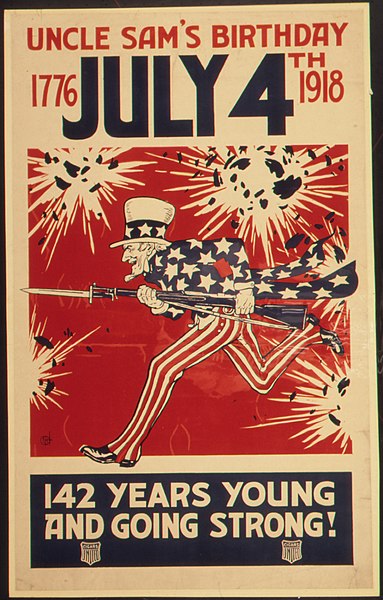
"142 Years Young and Going Strong!" ca. 1917-19. National Archives, Item  512445.

A brief post to mark Independence Day in the U.S. On July 4th, 1918, the United States had been involved in the Great War for several months and would continue its engagement until Armistice. Many felt that America's entry into the war, though it came after three years of strife, was pivotal in bringing this terrible conflict to an end. 

Vera Brittain, one of my recent research subjects, recorded a feeling of elation and relief upon seeing American soldiers arriving in France. Indeed, the above poster celebrates Uncle Sam's 142nd birthday and promotes--quite energetically--the image of a brave, agile, nation charging to victory on the battlefield. We feel confident in this nimble, fearless, Uncle Sam.

Happy July 4th to you, dear readers. I hope you have a chance to celebrate the holiday, to thank our veterans of yesterday and today, and to make a wish for peaceful enjoyment of everything that freedom means to you.

© Fiona Robinson

Monday, July 2, 2012

Easing Into the Twenty-First Century

Hello Dear Readers,
I am excited to tell you that "Ghosts of 1914" now haunts Twitter! Follow me there and you'll be kept up to date with the latest blog posts and other intriguing tidbits. Here's the link:

https://twitter.com/#!/Ghosts_of_1914

Cheers,
Fiona

Tuesday, June 26, 2012

Raise the Flag: Semaphore Signaling for War and Peace

Horace Nicholls. Girl Guides Practicing Semaphore Signaling, ca. 1914-18.© IWM, Item Q30965
I ran across this photograph of young women practicing semaphore signaling in a random search of the IWM's collections database. The two Girl Guides (whose scouting organization had been founded in 1910 by Robert Baden-Powell) seem quite serious about their enterprise, and for good reason. 


British semaphore signal flags, undated.  © IWM, Item FLA 849
Semaphore signaling was an important method of communication. A simple way of transmitting information at a distance, it originated in the late eighteenth century and came to have many uses. For instance, railroads were known to use semaphore signaling to control train traffic and ensure safety. The essential component of the system is the use of movable arms (above demonstrated quite literally) to hoist signal flags. According to a 1918 encyclopedia entry on signaling, the British Navy used a system of seven positions. An entire alphabet could be signaled depending on the positioning of the flags. The system is still used today, though much more rarely than it once was.

Semaphore Alphabet, from Capt. E.J. Solano's book, Signalling, 1918.

Women practicing semaphore signaling at a summer camp, Hertsfordshire, 1916.  © IWM, Item Q 108031
Women young and older clearly took an interest in semaphore signaling on the Great War homefront, as the two fascinating photos from the IWM's collection show us. Signaling officers on the battlefields, like the young man who once owned the set of instructional cards below, used semaphore signals to communicate important information during combat.
"Semaphore Signaling in a Week" instructional card set, ca. 1916. © IWM, Item EPH 2507
A British Pathe film from the war era shows multiple women demonstrating semaphore flag signaling at  an unknown location. Such evidence suggests that women's war efforts included the learning of the semaphore system as a way of mobilizing the homefront, of being prepared for emergency communications, should other, more technologically dependent, methods become unavailable.

Fascinatingly, an anti-war symbol that we all recognize is based on semaphore signals. As an informative BBC News article details, the peace sign was developed by Gerald Holtom, a conscientious objector during World War Two. His symbol debuted in the 1950s at a British protest demanding nuclear disarmament. The semaphore signals for "N" and "D," when combined, create the iconic image:

"Decoding the Logo," BBC News Magazine.
The artifacts we have here show us that semaphore signals were an essential part of information transmission on the battlefield and a part of women's homefront service during the Great War. The semaphore system, with its instructional silhouetted figures gripping flags or photographs of eager young people practicing with arms held aloft, is one example of  communication, already heavily electronically mediated by the time of the war, remaining human--conveying important military messages, homefront anxieties, and, eventually, hopes for a more peaceful world.

© Fiona Robinson

Friday, June 15, 2012

Dr. Dolittle Goes to War

I once had a conversation with an advisor about the possibility of contracting academic shellshock from researching and writing about war literature. I believe we agreed that it was indeed possible. Truly, it isn't always easy engaging so deeply with the grim and arduous topic of war and its literary expressions. But no grad student would describe any dissertation as a walk in the park. Thus, how much of my occasional academic malaise has to do with war and how much to do with the mere process of writing a dissertation remains a mystery as yet unsolved.

A surprisingly effective remedy came my way this evening, though, from none other than the wonderful Dr. Dolittle. Yes, that Dr. Dolittle, the protagonist of Hugh Lofting's endearing series of children's books, the first of which was published in 1920.

Author Hugh Lofting
My route was circuitous, as usual, but I began by looking for further materials related to service animals in the First World War. I found a veritable menagerie in the IWM's collections database, including reindeer (yes, reindeer), an eagle, pigeons, a lemur, dogs, cats, mules, and horses. And then I found this charming photograph:

Varges Ariel. British Officer of the Army Veterinary Corps in Salonika with his Pets, 1916. © IWM, Item Q 32252.
The British veterinary officer with his jackdaws, goose, dog, and wolf cub seems a veritable Dr. Dolittle, friend to and communicant with all creatures great and small. The photograph made me go hunting for information about the books, which I first encountered in a school library as a child of about eleven.

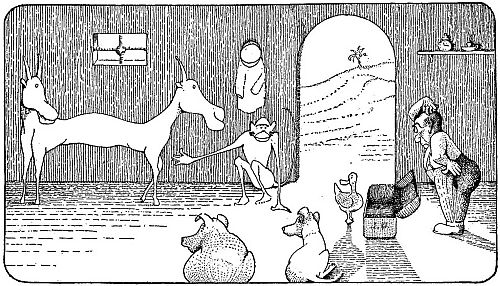
“'Lord save us!' cried the duck. 'How does it make up its mind?'”  The Story of Dr. Dolittle.

To my surprise, I found that Dr. Dolittle is in fact a ghost of 1914. His creator, English-born, MIT-educated, civil engineer Hugh Lofting (1886-1947), served with the Irish Guards in the First World War. When writing home to his children, Lofting chose to protect them from the gruesome details of trench warfare. Instead, his letters featured the beginnings of the Dr. Dolittle stories. It is amazing to think of the way this fictional character allowed Lofting to create a bit of innocence amid the strife of the battlefield.
He was very fond of animals and kept many kinds of pets. Besides the gold-fish in the pond at the bottom of his garden, he had rabbits in the pantry, white mice in his piano, a squirrel in the linen closet and a hedgehog in the cellar. He had a cow with a calf too, and an old lame horse—twenty-five years of age—and chickens, and pigeons, and two lambs, and many other animals. But his favorite pets were Dab-Dab the duck, Jip the dog, Gub-Gub the baby pig, Polynesia the parrot, and the owl Too-Too.
--The Story of Dr. Dolittle, p. 3.
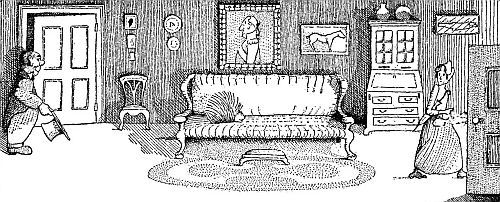
 “And she never came to see him any more” 
(A disgruntled patient leaves after sitting on a hedgehog) The Story of Dr. Dolittle.
Lofting was wounded in the war and eventually moved to Connecticut (my erstwhile home) with his family. In his lifetime, he would write and illustrate twelve books about the eccentric Doctor, who hails from a town called Puddleby-on-the-Marsh and learns to talk with and heal animals and undertakes many amazing adventures with them around the world and beyond. Dr. Dolittle enjoyed several incarnations on the stage and screen and continues to be a beloved hero of fiction.

There are many fantastic web resources on Dr. Dolittle, including full-text (with illustrations!) books on Gutenberg and Google Books. Karen Welbourn's Puddleby-on-the-Marsh website has a treasure trove of information and materials related to Lofting and Dr. Dolittle.

I hope you have enjoyed this lighthearted little jaunt with Dr. Dolittle and me. This merry ghost of 1914 certainly brightened a grad student's day of slogging through the dissertation trenches.

© Fiona Robinson


Wednesday, June 6, 2012

The Imperial Camel Corps

My apologies to my readers for a brief hiatus over the past couple of weeks. A number of things--vicissitudes and dissertissitudes--have made for little blogging time recently. Today, though, I wanted to share with you a wonderful, unexpected, artifact and some of the fascinating history that came with it. In so doing, we will continue our exploration of service animals in WWI, having previously considered the histories of cats and, to a small extent, horses. Whilst looking through the IWM's collections database for a couple of different blog-worthy items (related to tea-making and souvenir-taking on the front), I came, circuitously, across this magazine:

Barrak: The  Camel Corps Review, 1 Sept 1917. Cairo. © IWM, Item Documents.9964
Not only was there an Imperial Camel Corps during the First World War, but there was also a periodical, entitled Barrak, dedicated thereto, as you can see from the example above. The Corps was started in January, 1916, and served on fronts in the Middle East. It was not, you may be surprised to find, the first camel-mounted British military unit. The Imperial's predecessor, the Somaliland Camel Corps, was initiated in 1912, and endured until 1944. A colonial protectorate with ties to their imperial holdings in India, British Somaliland, part of present-day Somalia, was under British rule from the 1880s to 1960, except for a brief period of occupation by Italy in the 1940s. The Somaliland Camel Corps enforced British governance of the protectorate. Its numbers were largest during its earlier phase, with up to 700 riders fighting rebels in the area during the Great War years.

Though the Somaliland Camel Corps bears its own fascinating history, we are here today to explore the Imperial Camel Corps, founded specifically for service in the Middle East during the First World War. Pro-Turkish tribespeople began to revolt in Egypt in 1916, and the Corps (known as the ICC) was organized to quell this rebellion, according to the Australian War Memorial's excellent web page on the ICC. ICC troops were enlisted primarily from Australia, New Zealand, and Britain, with Indian soldiers later joining their ranks. With the shift from patrol to combat in Egypt, the ICC was reorganized into the Imperial Camel Corps Brigade by the close of 1916. Four battalions within the brigade were established by 1917, and with the addition of the Hong Kong and Singapore Mountain Battery, as well as a machine gun squadron, Field Ambulances and medical support for soldiers and camels, and a Royal Engineer Troop, among other supports, the ICC Brigade became a formidable military force. For those who want to know more, New Zealand History Online has a great article on the organization of the ICC.

Hong Kong and Singapore Mountain Battery troops training. Australian War Memorial, Item B01465.


Australian Camel Company, ca 1914-18.

Camels were considered an ideal service animal for the Middle Eastern front, as they were naturally adapted for the terrain and climate. The camels who served in the ICC were initially brought in from the north Indian district of Bikaner. This princely state had its own camel-mounted unit, known as the Bikaner Camel Corps, whose Imperial Service Troops also fought for the British Army in Egypt.

Bikaner Camel Corps in Egypt, ca 1914-18.
Camels are sturdy animals, and both the Indian and the Egyptian camels who also served in the Corps were able to carry soldiers and their equipment at an impressive clip in the desert sands. They also managed to remain calmer in combat situations than their equine counterparts. Typically, camels would transport men, sometimes known as cameliers or cameleers, and goods, with troops dismounting to engage in artillery combat.  The Australian War Memorial's collection database has an extraordinary assortment of objects and media representing life in the ICC.

George Lambert. Camel, Abbassia, full marching order. 1918. © Australian War Memorial. Item ART02744
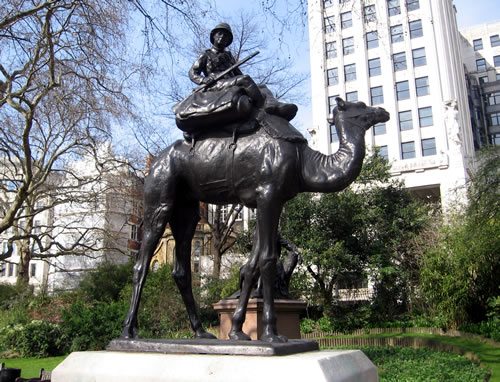
The ICC Brigade served gallantly in Egypt and Palestine through to Armistice. Combat in Palestine began to necessitate transition for Australian and New Zealand troops of the ICC, who were moved into horse-mounted battalions. Notably, near the end of the war, two of the British battalions who had remained in the Brigade played an important role in the Arab Revolt, alongside T.E. Lawrence ("Lawrence of Arabia"). By the time of the ICC's complete disbanding in May, 1919, nearly two hundred fifty casualties had been sustained among its British, New Zealander, Australian, and Indian members. A memorial to the Imperial Camel Corps was installed at Victoria Gardens, London, in 1921.

ICC Memorial, © New Zealand History
The mounted soldier and his camel are startling and somewhat poignantly situated in the verdant park, especially against the backdrop of modern skyscrapers as shown above. They seem to pause amid a long and arduous journey from a world far away, reminding us that the ghosts of 1914 hail from many reaches of the globe and represent a much stranger, more curious, set of histories than we may initially assume.

© Fiona Robinson