Wednesday, December 21, 2011

At the Movies: War Horse

I am eagerly anticipating the premiere of War Horse!

Still from War Horse, 2011.

One of the highlights of my 2010 trip to England was watching the stage adaptation of Michael Morpurgo's beautiful 1982 novel. It was breathtaking to see the life-size horse puppets prance, rear up, and gallop around the stage during the production in the West End. I couldn't believe how much emotion they (and their amazing puppeteers) were able to draw out from the audience. It was one of the most vivid examples of the sort of investment--that feeling of being gathered into, enfolded within, drawn to grant one's care and attention to something--that great drama and great literature can inspire in us.


I will be waiting (patiently!) to see the film version when it debuts here in the U.S. Regardless of the film's living up to my high hopes, though, my encounter with War Horse on the page and on the stage has been a fascinating one and I highly recommend the book and the play. They both illuminate the role of animals who served in the Great War--a deeply important aspect of the history of this conflict and one to which I will return in later posts.

© Fiona Robinson

Tuesday, December 20, 2011

Ghosts of Christmas 1914

A British officer's photo of soldiers meeting during the Christmas Truce of 1914. © IWM, Item Q 11718.

Greetings, readers. Happy Hanukkah to those of you celebrating the first day of the holiday! Today, I wanted to write about a singular event during World War One: the Christmas Truce of 1914. Though it was for a time regarded as a rumor or myth, this remarkable event really happened and is well-documented in written and visual records. On various stretches of the front lines, a truce in honor of the holiday was called, informally, between British and German soldiers. It lasted roughly from December 25, 1914 to January 3, 1915. What I find so compelling about it, as many others do, is that in the midst of a brutal combat, soldiers on opposing sides could choose to put down their weapons and interact in a spirit of brotherhood and goodwill. What an amazing thing that our ghosts of 1914 did during those several wintry days on the battlefield! 

Soldiers from the British and German armies gathered to play games, exchange various souvenirs, and, poignantly, to bury comrades fallen in previous days of fighting. There are some incredible photographs artifacts related to these events in the Imperial War Museum's (IWM's) collection:
British and German officers meeting during the Christmas Truce, 1914. ©IWM, Item Q 50721

German Bierstein given to Pte. Bill Tucker in honor of winning a Christmas football match. ©IWM, Item EPH 3147

For those of you wanting to research the Christmas Truce, the village of Kinnethmont website has a stellar description of the event, with artifacts. Wikipedia's "Christmas Truce" entry notes that a memorial to the truce was dedicated in 2008, with descendants of soldiers from both armies participating in its commemoration. The Guardian also has a nice, brief, selection of first-hand accounts of the truce. Use the keywords "Christmas Truce" to search the IWM collections database, and you'll discover many artifacts and manuscript items. The 2005 French film, Joyeux Noel, looks at the truce from the perspective of various soldiers.

The temporary embrace of peace was both miracle and tragedy--that it was possible, even for such a brief time, made it all the more heartbreaking that it was abandoned and combat resumed once again. However, that soldiers were able to set aside differences of all kinds and relate to one another as people did much to destabilize nationalistic sentiment on both sides. In fact, so potentially threatening to the war were these several days of peace that both sides' armies resolved that there would be no repetition of the Christmas Truce in subsequent years. War offices also worked to repress the truth about the truce, such that it was regarded as only the stuff of legend for some time afterward.

Until the next time we visit the Ghosts of 1914 and of Christmases past, I wish you all a very happy and peaceful holiday.

© Fiona Robinson

Thursday, December 8, 2011

What to Get for the Soldier on the Front

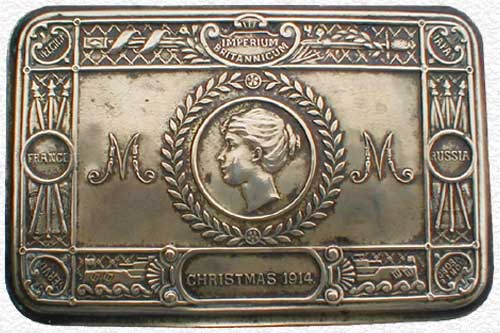
Christmastime is upon us, though we have not had any snow in the last month here in Connecticut and the weather is confusingly blithe. In spite of the friendly temperatures and distinct lack of a need for boots/gloves/hat/scarf at all times, I have begun my Christmas shopping and am doing a bit of holiday crafting each evening. It seems to be time to bring the Yuletide to "Ghosts of 1914," so I thought I would write a bit about the wartime gift meant for everyone in the British Army: The Princess Mary Christmas Gift Box.
The Princess Mary Christmas Gift Box, Village of Kinnethmont, Scotland, website.
James M. Grant's Village of Kinnethmont website has a lovely overview of the Christmas Gift Box's history and contents. According to Grant and other sources, Princess Mary, the daughter of King George V, established a Christmas Gift Fund for soldiers and sailors in November, 1914, to collect contributions towards a present for those on the front. Donations were plentiful, and it was decided that the best present for each soldier or sailor would be a metal box with thoughtful treats and other items. So thoughtful was the gift, in fact, that there was a version for smokers and for non-smokers!

Christmas Box and contents for smokers, © IWM, EPH 1992.

Writing Stationery from a non-smoker's Christmas Box, ©IWM, EPH 2073.
Beyond the differences for smokers and non-smokers, the boxes contained different assortments of items, depending on their recipients. Mr. Dick Elliot, of cigarhistory.info writes about the Gift Box that:
Officers and men on active service afloat or at the front received a box containing a combination of pipe, lighter, 1 oz of tobacco and 20 cigarettes in distinctive yellow monogrammed wrappers. Non-smokers and boys received a sterling silver bullet pencil in a .303 cartridge and a pack of sweets instead. Indian troops often got sweets and spices. Nurses were treated to chocolate. Contrary to opinion, they did not contain cigars. Many of these items were distributed separately from the tins themselves, as once the issue of tobacco and cigarettes was placed in the tin there was little room for much else apart from the greeting card.     
--Dick Elliot, "The Princess Mary Tin"  
In addition to the soldiers and nurses who received the boxes, the families of those who had been killed prior to Christmas, 1914, were also entitled to a tin. Though not every soldier received a box  that year, due to the hazards and complications of delivery during combat, it is a testament to the tins' wide distribution and their sentimental value that the IWM features several (kept by veterans and/or their families and donated to the museum) in their permanent WWI galleries, as I observed when there in June, 2010. The museum's "Women, War, and Society" database also includes many documents relevant to the history of Princess Mary's Fund and the Christmas tins.

The BBC Schools WWI website has an intriguing little interactive feature that includes a Christmas Gift Box among other artifacts that a typical British soldier would have amassed during his service.

Well, we'll close the lid on this little Christmas Box post for now, but we will continue the holiday-themed entries at "Ghosts of 1914." In light of the time of year and perhaps in honor of the ghosts of 1914-1918, I hope that you will consider a holiday contribution of some kind for veterans or soldiers serving today. Until next time, may your days be merry and bright.

© Fiona Robinson

Thursday, December 1, 2011

What to Wear to War II: Footwear on the Front

As I was walking home from campus the other day, I noticed a woman wearing flip-flops. Despite the late November date and our location in New England, it was technically warm enough for such a choice. As a matter of fact, she was not the only person with such footwear that day. I myself was wearing tall brown boots, but it amused me to think that the rather unseasonably temperate weather we've been having this autumn permitted both options--the summery sandal and the sturdy boot--to be appropriate. One perhaps best reflected the weather and the other the season.

As often happens as I make my way on foot from here to there and notice such things, I began to wonder what this particular aspect of life was like for our Great War counterparts. What sort of footwear did the average soldier and officer wear on the front? 

I have discovered that the average soldier in the British Army would have worn "ammunition boots," so called because of their procurement via the Royal Artillery headquarters rather than that of the British Army. They looked like this pair, in the IWM collection:
British boots, WWI era. ©IWM, Item UNI 12346.
A contemporary version of the boots, sold at "Beckett's Adventure," a European Army/Navy surplus store, is fairly faithful to the original.
Modern "Ammo Boots."
As you can see from the above photo, the soles of Ammunition Boots had metal studs or spikes to help them grip. One can imagine the peculiar crunching sound that they would have made as soldiers marched along. While soldier's boots were issued by the British Army, officers would have purchased their own uniforms and boots. They had more leeway with color and style. A typical officer's boot is represented by this pair, also at the IWM:
British Army Officer's Field Boots, WWI. © IWM, Item 12635.
Boot-making employed many women during the war (and, no doubt, in peacetime as well). The need was enormous and, in many industries, women staffed factory positions that enlisted men had left vacant. A young lady, who may or may not be a war worker, assembles a pair in the below photograph:
G.P. Lewis photo of a woman in a boot factory. Imperial War Museum. © IWM (Q 28105)
If boot-making was not her occupation before or after the war, is it too fanciful to imagine that, amongst the heaps of boots that passed through her hands, this woman might have helped make a pair for the soldier who had stood working, in peacetime, at this very machine? Or, did her thoughts turn to loved ones on the front as she stitched, wondering if the boots she made that day would help someone she knew?

Trench boots were devised to help protect soldiers from the painful and dangerous "Trench Foot." The cold and wet of the trenches, combined with a soldier's usual inability to remove his boots and change to dry ones, or even to dry socks, put many men at risk. These tall rubber waders were the sort of footwear issued to try and prevent some of the ills associated with such rough conditions:
British Army issued Trench Waders, Imperial War Museum. ©IWM, Item EQU 3888.
There you have an initial glimpse at what you might have seen on the feet of fellow soldiers or officers in the British Army, had you been on the front. Stay tuned for more on Great War apparel, uniforms, and equipment next time we consider "What to Wear to War" at "Ghosts of 1914."

© Fiona Robinson

Monday, November 28, 2011

India in Flanders Field II: Gandhi and The Great War

I have been considering a number of topics for my second post on the Indian homefront during the Great War. Not knowing a lot about this aspect of First World War history, I thought it would be good to continue with broad areas of inquiry. I've been wondering what Indian sentiment about the war was like. How much conflict did the idea of serving in the British Army create? Coming at a pivotal time during the Indian independence movement, how did the war affect Indian civilians and those who served? 

Within the topic of the Great War in India, one of the first names that appears amid the researcher's retrievals is, unsurprisingly, that of Mohandas K. Gandhi. 

Gandhi, 1918.

With his early career prior to the war currently the subject of an acclaimed production at the Metropolitan Opera, Gandhi remains a figure of fascination and admiration around the world. He is remembered for being an advocate of peaceful resistance during his leadership of the Indian Independence Movement. 

By 1914, Gandhi, who trained as a lawyer in London, had galvanized the Indian civil rights movement in South Africa. It was during this time that he developed and promoted the idea of satyagraha, or peaceful civil resistance. The concept of satyagraha has many inflections: Gandhi wrote extensively about it, describing its meaning as a composite of the values of steadfastness, truth, love, and nonviolence.

Around the start of the First World War, Gandhi traveled to England. Having organized Indian volunteers as ambulance drivers during the Boer War, Gandhi again urged Indians to serve in these noncombatant positions. He returned to India in 1915 and his role as a leader of the independence movement began to coalesce around this time. The war years were extremely active ones for Gandhi: in Champaran and Kheda, he led resistance movements among peasants and farmers who struggled with hunger, unsafe and unhealthy living and work conditions, oppressive and unfair treatment by employers, and poverty further exacerbated by excessive taxation. Gandhi's Satyagraha revolutions, as these movements were called, achieved resolution between the British government and citizens, ending the crippling taxation and allowing for recovery from the famine created by the dire straits into which the farmers had been thrown, having had to grow crops for trade rather than the food they needed. The success of the Champaran and Kheda Satyagraha brought Gandhi to national and worldwide prominence.

It would be in April of 1918, when Gandhi attended a War Conference organized by the Indian Viceroy, that he made a striking departure from his earlier advocacy for noncombatant service. Vowing that he would work towards Indian combatant recruitment, Gandhi issued an appeal for service in the British Army. Though it would create controversy because of its contradiction of the nonviolence for which he had become renowned, the push for Indian recruitment was connected deeply with the Home Rule movement. It was hoped, perhaps paradoxically, that, by helping the British Army, India could delineate its own identity as a powerful and independent nation--more like an ally for England rather than some subordinate entity. There was also hope that Britain would extend independence to India in gratitude for this military service.

Gandhi's 1918 call for recruitment would remain one of his most controversial choices. It is perhaps easy, in hindsight, to question his decision to support Indian  combatant service in the British Army.  This moment of conflict within a conflict reflects what was an enormously volatile moment for Britain and India--one nation's appropriation of the other's people, resources, and government began to fade as the other progressed towards full independence. The course to independence was not smooth, and Gandhi's vacillations on combatant service reflect various approaches to the question of how India could re-identify itself as a nation of its own. The war seemed, for a while, to be a catalyst for that reinvention--for an unprecedented assertion of the very independence India sought through chosen service.


© Fiona Robinson


Sources and Further Reading:

Metropolitan Opera information on 2011 production of Philip Glass's Satyagraha:

Wikipedia: "Mohandas Karamchand Gandhi"

image of Gandhi in 1918:

Wikipedia: "Champaran and Kheda Satyagraha"

About.com: "Mohandas Gandhi--Biography"

Gandhi Book Centre: 

***more to follow***

Friday, November 18, 2011

Queen Mary's Needlework Guild Badge

As those of my readers who are fellow graduate students might know, we are subject to the vicissitudes of dissertation research--the "dissertissitudes," if you will, of writing, research, and editing--and whole weeks are known to pass whilst emails go unanswered and blogs go un-updated, among other things, when the tide turns suddenly and the dissertation takes control of one's life. This past week I have been refining a chapter about the New Biographers, adding details about our friend Geoffrey Malins and his amazing memoir (truly, one of the most fascinating ones I've read) and making other changes. It is a slow battle but I feel confident that the victory flag will be raised (hopefully later today!) and the chapter will be done! Until it must be revised again, that is.

I wanted to post briefly today to add a little to my earlier post about knitting in the Great War. I have recently acquired a darling badge that once belonged to an official in the Queen Mary's Needlework Guild. It looks like this one at the Aberdeen Art Gallery and Museum:

Queen Mary's Needlework Guild Badge, 1914. Aberdeen Art Gallery and Museum.

As an avid needlewoman, currently engaged in one of the biggest knitting projects I've ever done, it makes me happy to own a little piece of history that signified another woman's pride and sense of purpose in her needlework and service. I don't have, currently, any details about the original owner of my badge, but I will try to do a bit of research and will share what I gather.

I do know that the badge is one that would have been purchased and worn by an official in the Guild. Regular members could purchase and wear a simpler but still elegant badge. So the woman who first wore the badge I now own would have been a leader of some sort in her community. She would have likely organized other members and solicited contributions from knitters and sewers in the area. No doubt, the beautiful little badge was pinned proudly on her coat or dress, and transformed her outfit into a sort of civilian's uniform. 

The badges were still in use through the 1950s, as far as I've been able to find out. The design changed slightly (the "M.R." initials were altered into an intertwining arrangement) sometime after the Great War, but the Guild's mission remained the same. Today, it is known as the Queen Mother's Clothing Guild.

Well, that is all for this morning. Happy knitting or sewing to my fellow needlepeople and happy writing to my fellow graduate students. Join us again at "Ghosts of 1914," where I shall be posting soon about the Indian homefront in the Great War.

©Fiona Robinson

---


Sources and Further Reading:


Monday, November 7, 2011

Poppies on November 11th

In honor of the upcoming Remembrance Day (or Veterans Day, as it is known here in the U.S.), the poppies of Maurice Kirth:

Maurice Kirth. Wear a Flanders Poppy. Poster, ca. 1918-1938.

In Flanders Fields, the poppies blow
Between the crosses, row on row...
--Lines from John McRae's "In Flanders Fields"

It was John McRae's eerie poem, "In Flanders Fields," first published in Punch in 1915, that inspired American YMCA worker Moina Michael, herself a poet, to begin the tradition of wearing a red poppy to honor the dead of the First World War. Michael initiated the poppy's symbolic appearance on lapels in 1918.

I will be attending Yale's Veterans Day service this week. I hope that you will also honor the fallen in some way and, importantly, the living who have served in the military or who serve today. May we all, even though we may have different feelings about war, be thankful for the contributions of veterans and welcome them to a place of health, happiness, belonging, and opportunity in our society.

© Fiona Robinson
----

Sources and further reading:

Wikipedia: "Moina Michael":

Wikipedia: "Remembrance Poppy":

Wikipedia: "John McRae":

"In Flanders Fields" reprinted in Poems from Punch, 1909-1920. Macmillan, 1922.