Monday, October 29, 2012

War Poems for Halloween


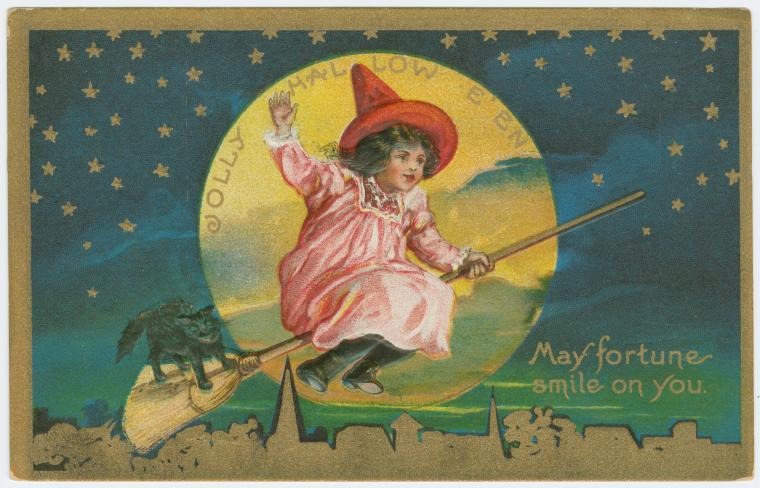
"A Jolly Hallow-e'en" Vintage Postcard, ca. 1910. © NY Public Library Picture Collection.
A fascinating find for Halloween week:

Winifred M. Letts's Hallow-e'en and Poems of the War is widely available online for those of you would like to delve a bit into Halloween and Great War history.

Letts, born in 1882, was of English and Irish heritage. She was also a versatile writer, penning novels, poems, plays, and children's fiction over her career.

The Halloween-themed poems in Letts's collection are touching, rather tragic, musings. They offer an older-world vision of Halloween as a holiday when the spirits of the dead might return to familiar places and people. "Hallow-e'en 1915," for example, is an emotional appeal to the war dead, hoping that they will be drawn by the welcoming lights of home. Hearth fires, stars, lanterns, and lamps are all described as beacons for the "well-beloved dead."

O men of the manor and moated hall and farm
Come back to-night; treading softly over the grass;
The dew of the autumn dusk will not betray where you pass;
The watchful dog may stir in his sleep but he'll raise no hoarse alarm.
--Winifred M. Letts, "Hallow-e'en 1915," (5-8)
Other pieces of note in this great collection are "The Deserter," a well-known piece that considers the plight of those too fearful to fight, and "A Sister in a Military Hospital," about nurses much like those whose uniforms might inspire a costume or two, as I have written previously.

Letts's book connects Halloween to the First World War in an unexpected way, offering a different perspective on the holiday than the one we might know today. In her poems, mingling with ghosts on "Hallow-e'en" is a longed-for reunion rather than a spooky thrill. Most importantly, however, Halloween is for Letts, as it remains today, a time of possibilities, a brief night when real and unreal can come together and a slightly different, more magical, world appears.

© Fiona Robinson

Monday, October 22, 2012

What to Wear to War: A Nurse's Halloween

Hello Dear Readers,
Today I'm celebrating the first birthday of Ghosts of 1914! I'm delighted to have kept the wheels turning on our journey into Great War history. Thank you for joining me along the way!

I'm also sitting here on a rainy Monday thinking about Halloween costumes. I love historical costumes of various kinds and I'm determined to put my sewing skills to work at making a flapper dress at some point. I made one a couple of years ago and loved it, but this next time around I'd like to make more of a Robe de Style, which was a transitional style somewhere between the lighter post-Victorian gowns of the late 1910s and the remarkably daring ones of the Jazz Age. Here are two lovely examples of the amazing Jeanne Lanvin's Robe de Style in the Met Museum's collection:
Jeanne Lanvin. Robe de Style, 1924-25. © Metropolitan Museum,  New York.
For those of us who love historical costume related to the Great War, furthermore, there are plenty of ideas. Last year, I wrote a bit about various uniforms, including that of the British (V.A.D. or Red Cross) nurse. In a pinch, a respectable replica could be whipped up from a long grey cotton dress or skirt with a collared shirt, a simple white apron (with optional red cross painted or sewn on), some white cuffs (for instance snipped from the sleeves of a worn-out t-shirt), and a deftly tied white headscarf. For example, from a nifty article on the UK Red Cross's blog, here is one of Britain's most famous WWI nurses, Vera Brittain, in uniform:
Vera Brittain, ca. 1915-18. 
Taking things to an even more intrepid level, the National Library of Scotland has some great images of two women who served directly on the front line as nurses and ambulance drivers:
Mairi Chisholm (?), Nurse, ca. 1914-18. © NLS, Acc 8006 (i).
Mairi Chisholm and Elsie Knocker were, according to the National Library (NLS), the only two women permitted to serve on any Western Front battlefield. Explore the NLS's "Women in the First World War" learning site to find more details about these remarkable ladies and some of their peers. As for a Halloween costume, Mairi's trench coat and waders/high boots, as well as her messenger bag and helmet, could be replicated with modern finds and would make for a really exciting innovation on the standard nurse's uniform.

Well, I'll close for now, but there are a couple of ideas for Great War-inspired costumes that can easily be constructed out of items you may have in your own closet or that can be found at the local thrift store, army/navy supply, borrowed, or purchased inexpensively elsewhere. For more on First World War costumes, take a look at my earlier posts on this topic. And, I will be back to suggest even more ideas before the big holiday arrives! 

Till later,
Fiona

© Fiona Robinson


Thursday, October 11, 2012

On a Professional Note...

Hello again readers,
Because yours truly just finished her dissertation, it is now time for me to look for a job!

For interested parties, my professional portfolio site, otherwise known as "The Bookish Writer," is now live at:

http://bookishwriter.wordpress.com/

If you are in need of a writer, museum assistant, editor, researcher, teacher, or publishing associate, please let me know!

Cheers,
Fiona


Hello again!

Hello dear readers,
I am back from the time warp that was submitting and shipping my dissertation! What a whirlwind the last month has been. And there's no rest for the weary. Between a short-term writing gig and some other projects and what-not these days, I am a busy little bee.

I just wanted to pop in here to let you know that, though I may have finished the biggest academic project I've yet done, a culmination of the ten or so years I've spent thinking about and working on the First World War since college, the Ghosts of 1914 are still with us--and me.

In the days after I turned in the dissertation, when everyone was saying, "you must be so relieved!" and "now it's time for a rest!" I'd nod, smile, and then think, "I sure wish I felt relieved and/or restful..." There are reasons for my lack of celebratory insouciance. Of course, handing in a dissertation is not the end of that particular process--there are numerous reviews that must take place before a degree is awarded. Waiting is the name of the game now. And, like many young academics in my position, I'm at a point between education and career when the next (professional) chapter is yet to be written and leaving the safe, structured, world of grad school (though it has its tribulations, of course) is thus a difficult prospect. Finally, the truth of having "finished" the last and most pivotal requirement of graduate school takes a long time to sink in.

Anyway, when one is at such a crossroads, it can be tempting to look, with a sudden flash of gleeful spite, at the books and papers that have set up shop in one's home and life--on desks, bookshelves, floors, bookbags, etc.--over the last several years and begin gathering, flinging, discarding, banishing...you get the idea. I've known the pleasure of returning literally hundreds of library books and throwing out old drafts, and I've imposed mental quarantines forbidding certain authors or topics at such moments in the past.

However, I haven't really felt this urge this time around. Perhaps it's all still too new. But, I think there's another--better--reason. When I look at my bookshelves, I realize that my copies of Virginia Woolf, Lytton Strachey, Vera Brittain, Siegfried Sassoon, Helen Zenna Smith, Sir Arthur Conan Doyle, and so many others are old friends. Furthermore, I am still curious about so much of Great War history, culture, and arts. I still have so many questions and I can sense that there are so many stories that still need to be recovered from this moment in time.

While the climb was burdensome at times, I've gotten to the top of Dissertation Mountain and I can say that the view is dazzling. It's not entirely clear what all lies before me, but I do know that there is much more to explore. I've got WWI projects already up my sleeve, to be sure--more research I'd like to do, more writing (both academic and non-) I will do. And Ghosts of 1914 is definitely here to stay. This blog has been a delight and a source of support during the last year. Here, I've had the joy of pursuing detours and by-roads in WWI history and knowing that a community of readers joins me in my explorations.

Thank you for reading and do stay tuned. In the next weeks, I'll celebrate the first birthday of Ghosts of 1914 with plenty of new posts. It's good to be back.

Cheers,
Fiona

© Fiona Robinson


Monday, September 17, 2012

CWGC: Forever India

I am deep in the mire of the dissertation trenches...No time to write much, as my submission deadline approaches in just two weeks! However, I did find this fascinating resource, one of many on the Commonwealth War Graves Commission website, that I wanted to share with you:

"Forever India"
http://www.cwgc.org/foreverindia/

Unidentified image of two Indian soldiers and a tiger, not dated. Copyright 2012, CWGC. 
Please enjoy the riches of the "Forever India" web resource, full of information about the service and sacrifices of Indian citizens during the Great War. I will be back soon for more extensive forays into WWI history with you.

Cheers,
Fiona


Thursday, September 6, 2012

Searchlights

T.B. Meteyard. "Searchlights Over London," 1917. © IWM (Art.IWM ART 17172)
Just an image today, from the IWM's ever-wonderful collections database. Meteyard's beautiful painting illustrates a definitively modern moment in London. Searchlights, which came into use in 1916 in England, strike bright beams through a murky atmosphere. Though they are powerful, it seems ominously doubtful whether they can illuminate more fully the gloom that pervades this scene. A mid-war meditation, certainly.

The peak of Dissertation Mountain is within sight! It will be a few weeks before I'm done, but I'm getting there. Thank you for reading!

© Fiona Robinson

Tuesday, August 28, 2012

A Trek on Dissertation Mountain


"Mt. Fuji in Autumn."Gorota Kawai fl.ca. 1920-30s
O snail
Climb Mount Fuji,
But slowly, slowly!
                                                   --Kobayashi Issa

I am quite busy these days with dissertation writing. The good news is that I have, technically, written all of the chapters. The less than wonderful news is that I have a lot of revisions to finish. And that means that the next several weeks will be spent, in large part, obsessing about Virginia Woolf, Lytton Strachey, Vera Brittain, Siegfried Sassoon, and their literary friends and relations. When I feel overwhelmed at having to climb--or keep climbing--what I call Dissertation Mountain, I just think of myself as Issa's snail, tracing one little silvery dash behind him at a time. Mount Fuji can be climbed, even if slowly. And so can Dissertation Mountain.

Dora Carrington. Lytton Strachey, 1916. ©.NPG 6662

Another thing I do when I feel overwhelmed or disenchanted with this mountain of my making is to watch movies that have to do with my subject(s) or their time period while I work. It helps immensely to have the pleasant, undemanding, company of a familiar film while one types, deletes, has revelations, despairs, and returns to typing once again. One letter, one word on the blank page at a time, a veritable and virtual Mount Fuji slowly covered with the silvery snail tracks of my writing. The most important thing is to keep going!

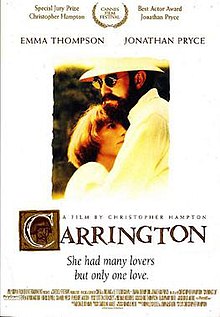
My film of choice right now is one of my all-time favorites. I've been in love with it since I first saw it over ten years ago, as part of a spectacular Bloomsbury art show at the Yale Center for British Art. I've watched it time and again and even used it in a course I taught at Yale about Bohemians in literature from Shakespeare to Kerouac. It is Carrington. Now, Michael Holroyd's Lytton Strachey and Gretchen Gerzina's Dora Carrington: A Life offer many more details than any film could provide about the lives of the two incredible figures portrayed. However, if you are a Bloomsbury fan, a twentieth-century enthusiast, a (secret) Bohemian, a fashion history person, a literature and/or art scholar, or a period drama film-lover, then do watch this movie. 
 

Carrington (1995)

I recall being annoyed when my own copy of Holroyd's Strachey arrived a few years ago, with the image of the film's stars as Strachey and Carrington emblazoned on its cover. As a rule, I do not approve of film posters as book covers or endorsements from modern authors on classic texts (among other things). But, much as I might not have liked receiving the Carrington-decorated copy of this beautiful biography, I do love this film. There are many reasons why I enjoy it so much. Sparing myself (and you) from too many of them, it's one of my favorites because it is about real people, an era, and art and writing in which I'm interested and, more broadly, because it's about human relationships that defy standard categories but are defined--wildly and genuinely--by love.

Enough, already. I must pack up this little encampment and seek higher ground on Dissertation Mountain. I hope you enjoy the film, the two biographies, or, if you are a fellow graduate student or writer or anyone with a mountain-like project in front of you, I hope that you can be inspired to keep climbing--but slowly, slowly!

© Fiona Robinson